
The Bread Lesson

Sex After Seventy - Episode Seven

There was a photograph. Nine months ago, on my telephone, from Argentina. Two coffee cups on a table and nothing else in the frame. No message. No explanation. Two cups.
I did not answer it.
And I want to be clear that I knew what it meant. I have been seventy-plus years old for a while now and I did not fall off a turnip truck. I knew exactly what it meant, which is why I turned the phone face down on the counter and went and reorganized the drawer with the batteries in it.
Here is my policy on romance, arrived at over two marriages, one divorce lawyer with a boat, and a summer in Reno I’ve told you almost nothing about. Romance happens elsewhere. On a ship. In a jungle. In a rented cabana with somebody else’s towels and a ceiling fan that doesn’t work. You go, you carry on, you come home, and you shut your own front door behind you. And the whole business stays out there where it belongs, like a raccoon.
What you do not do is let it in the house.
Because out there, in the dusk, on a boat, a man sees a woman with her hair down and her guard down and forty years knocked off her by candlelight and rum. In the house, at six in the morning, a man sees a pill organizer the size of a tackle box. He sees a grab bar. He sees a woman eating over the sink because that’s where she eats. Out there, I am a mystery. In here, I am an inventory.
So I didn’t answer the photograph, and I told myself that was restraint, and I let the months go by, and every single one of them I thought about those two cups.
Then he wrote and asked if he could come.
I would like to come and show you something.
That is the whole sentence. That is the entire communication. A man does not fly thousands of miles to show a woman something ordinary. I read it four times standing up, and then I had to sit down and read it another dozen.
I said yes at two in the morning, which is when I make my worst decisions and one or two of my best ones. By six I was at the kitchen table with a cup of coffee going cold in front of me thinking: what have you done, Mavis. What in the name of God have you done.
Eleven days
I had eleven days, and I did not spend them idly.
I ran that house like a landing. The pill organizer went in the sideboard. The heating pad went under the bed. The magnifying mirror, which shows you things no woman needs confirmed, went in the linen closet face-down like a body. I collected seven pairs of reading glasses out of that house. Seven. I have been living like a woman who cannot see and does not intend to admit it.
The grab bar I could not do anything about. The grab bar is bolted. I put a plant near it, which fooled nobody, least of all the plant.
On day four I took it all back out. Every bit of it. Because I am a grown woman in my own home and I will not be shamed by an appliance I need.
On day five I put it all back.
That is the part nobody tells you about being conflicted. It isn’t torment. It’s logistics. It’s the same heating pad going under the bed and out from under the bed until you’ve moved it a dozen times and you’re standing in your own hallway holding it, at your age, wondering what exactly you think you’re protecting.
I made a list. Eleven items, in pen. Number one was the pill organizer. Number two was the heating pad. Number three was a garment I bought for Earl’s vintage evening that I have not been able to make myself throw out.
I’m not printing the rest of them.
Donna came Thursday to borrow a cake tin she has never baked in.
“You’ve moved your couch.”
“I have not.”
“Mavis. I have looked at that couch for fifteen years.”
I said a friend was coming to stay. She waited. I said he was a widower from Buenos Aires. She said, “And?” I said and he’s a widower from Buenos Aires. She looked at the couch, and then she looked at me, and she left with my tin, and she took her time doing it.
The book club got nothing. They had only just stopped asking me about the jungle.
He came through customs with a cooler
I want you to see it as I saw it. A man gets on an airplane in Argentina, flies all night across an entire ocean, and the object he is carrying like a newborn is a cooler. He had paperwork for it. From a veterinarian. I did not ask. I have chosen a life in which I do not know.
He looked the way he looked at the retreat. Silver, quiet, and put together in a way that makes American men look like they got dressed during an emergency. He kissed me on both cheeks. He shook Velcrow’s paw, formally, like they were closing on a house. Then, before the cooler was off his shoulder, he asked whether there were frogs in this part of the country.
I said not in September. He said “Good,” and that was the end of it, and neither of us said Peru.
I had checked that yard twice. A woman keeps her promises.
Then he stood in the middle of my living room and looked around it the way a man looks at a horse.
“You have moved your furniture.”
“I have not.”
“Ah,” he said.
He does that. It happens repeatedly and it does not improve. He doesn’t argue. He doesn’t correct you. He just says “Ah” and lets you go on standing there with whatever you’ve said still in your mouth.
He put the cooler on my counter and said, “Now. We begin.”
It was ten o’clock in the morning. I said that was fine. I said it in a voice I have not used since 1974.
He opened the lid and lifted out a jar.
“This is Amalia.”
There is a moment, when a man says a woman’s name in your kitchen and it is not your name, when the floor moves slightly. Then he held it up to the window like a jeweler.
Amalia is his grandmother’s sourdough starter. Amalia is ninety-one years old. I did the arithmetic twice on the assumption I’d got it wrong the first time. I had not.
At the retreat I told that man that metaphorical children rarely turn out well. He has now given me one. She’s older than I am, she lives on a shelf, and she has never once said thank you.
“She is alive,” he said. “She is not something you own. She is something you keep.”
I said that was lovely. I said it about five times over the next two days and I meant it a little less each time.
“How often does she need feeding?”
“Every day. In the beginning, every day. Later you will learn what she wants.”
Every day. So does the dog, and the dog has never once learned what I want. Or said thank you.
He’d brought his own flour, two kilos of it in a cloth bag. He said nothing about what was in my cupboard. He moved it to one side, which is its own kind of remark.
“You must be firm with her,” he said. “Never cruel.”
I said I’d try. I’ve been told that before, though usually about myself.
The lesson
The mixing is nothing. Flour, a well, water, and you bring it together with your hands until it looks like paste and a poor decision.
“Now we wait. Twenty minutes. She does the work. We do nothing.”
So we sat at my kitchen table and did nothing, for twenty minutes, mid-morning. I have been on dates that went worse than that and cost me a blouse.
Then he said we’d knead. Ten minutes.
I said ten minutes is nothing.
Ten minutes is not nothing.
Heel of the hand, push away, fold over, turn a quarter. He put his hands over mine to correct the angle and I would like the record to show that I did not make a sound.
“Do not be gentle with it,” he said. “Gentle is a way of not deciding.”
I said I’d bear that in mind. I have been bearing it in mind ever since, and I’d like him to know it’s ruined a perfectly good week.
At minute two I was enjoying myself enormously. At minute four something in my shoulders filed a resignation letter.
“You are stopping.”
“I am resting.”
“Ah.”
He took over. And I need to tell you about the forearms. I noticed them in an entirely technical capacity, the way you’d notice a well-built porch. He worked that dough for six minutes without his breathing changing once, talking the whole time about hydration percentages, and I did not hear a single word of it.
Somewhere in there, Velcrow came into the kitchen and dropped a compression sock on the floor between us.
Marcelo looked at it. He didn’t say anything. He went back to the dough.
I would like to tell you that was the end of it.
Then I shook out my arms and said I was fine and I’d finish it myself. I was not fine, but I’d said it out loud, so now it was policy.
I got a minute. Push, fold, turn. Then something on my right side let go with an audible opinion, and I sat down in my own kitchen chair with flour to the elbow and my arms hanging off me like wet laundry.
“It is enough,” he said. “She is ready.”
“Is she ready, or am I done?”
He looked at the dough. Then at me. “Both can be true.”
Supper
He set the table without being asked. Two plates, two cups, the forks squared like he expected an inspection.
Then he took out a third fork, held it for a second, and put it back in the drawer.
Neither of us said one word about that, and I have thought about it every day since.
We were most of the way through the meal when he put his glass down.
“You did not come to Buenos Aires.”
I said I’d been meaning to. I said it had been a busy year. I said the dog doesn’t travel well and that’s true, incidentally, that is a documented fact about that dog.
“Mavis.”
Nobody has said my name like that since the Ford administration. I did not care for it and I would like it done again.
“You did not come,” he said, “and I did not stop asking. One of us was going to have to get on a plane.”
I made a joke. I don’t remember what it was. I’m usually good, and it was probably good, and he let it sit there on the table between us like a dish neither of us was going to eat.
Then he said the dough had to rise overnight, and it needed somewhere warm. Warmer than the kitchen.
“Where is the warmest room in your house?”
Reader. Eleven days. Four furniture arrangements, seven pairs of reading glasses, a plant deployed against a grab bar, and a list in pen. And not once, in all of it, had I prepared for the possibility that the man would ask me a logistical question.
It’s the bedroom. It has always been the bedroom. The vent comes up on that side and I have complained about it for years to anybody who’d hold still. I was not going to lie to a man about ductwork.
So I told him. He nodded. He said he’d come up and check her in the night.
The night
I put on the good nightgown. The one from Barcelona, bought for reasons that did not pan out at the time. I did my face at half past the hour like a woman with a plan, and I got into that bed next to a covered bowl of dough on my own dresser, and I lay there in the dark listening to a house I have lived in for twenty years make sounds I had never heard it make.
At midnight I heard him on the stairs. I arranged myself.
He looked at the bowl. He said the temperature was good. He went back down.
At two he came up again.
I was asleep.
I was asleep on my back with my mouth open and my night guard in. A night guard is not a discreet appliance. It is orthodontic hardware. You could jump a car with it.
He looked at the bowl.
He pulled the quilt up over my feet.
I was no longer asleep.
Then he went downstairs, and I lay there in the dark for forty minutes doing arithmetic on my entire life.
He came up a third time.
Now. I want to be careful here, because I have gone over this a great many times and I am not certain of my footing.
I have had that dream. I have had that dream twice since Peru and once, memorably and with no provocation of any kind, about the mailman. So I am aware of what my own machinery can produce at three o’clock in the morning, and I have learned not to take its word for anything.
But I have never once had a dream in which the man checks the temperature of a bowl first.
That’s my whole case. I’m not going to argue it any further.
At five thirty I woke up because the dough had gotten out.
It had climbed the side of the bowl, pushed the cover off, and come down onto my dresser in a slow, confident way, and it had gotten into one of the seven pairs of reading glasses I have no memory of putting anywhere. Ninety-one years old and she got further in one night than I did.
Another pair of glasses was on the left side of the bed.
Nothing has been on the left side of that bed since 2011. I put them there myself, presumably, at some point, for some reason. A woman puts things down.
Morning
The kitchen at six was warmer than it had any business being, and the whole house smelled like something I don’t have a word for, and Marcelo was at my stove in yesterday’s shirt with the sleeves rolled, sliding a loaf into an iron pot.
And I could not lift my arms.
I mean it. Nothing the night before, and then at six the next morning I could not get a coffee cup down off my own shelf. I stood there in my robe doing an impression of a woman being held up at gunpoint.
He got it down for me. Then he reached up and got a second one, and set the two of them side by side on the counter.
Two cups. Nothing else in the frame.
He didn’t look at me while he did it, which is how I know he knew what he was doing.
So I stood at that counter looking at two coffee cups, and I thought: well. All right, then.
He put his hand flat between my shoulder blades and pressed, once. “Tomorrow will be worse.”
“Thank you, Marcelo.”
“I am only telling you.”
He was right. It was worse.
Then Velcrow came in from the living room and put my list on the kitchen floor.
Eleven items. In pen.
Marcelo picked it up. He read the whole thing, top to bottom, and I stood there with dough in my hair and no working arms, unable to physically take it away from him.
He put it down on the counter.
“Number four is not true,” he said.
And that is all he said about it, and he has not mentioned it since, and I am not going to write down here what number four was.
The bread came out the color of a saddle, and when he cut it the whole thing sighed. We ate half a loaf standing up at the counter with butter and nothing else. Velcrow sat between us with his chin on my foot, going quietly insane from the smell.
Four o’clock
He fed her and wrote the instructions on an index card in handwriting like a wedding invitation. Every day at first. Later you will learn what she wants.
At the door I had two questions.
I asked him the safe one.
“Why bread?”
He took my face in both hands, which I was not expecting.
“Because you would have said no to anything else.”
Then he said something in Spanish that I didn’t catch and am not going to look up, because if it turns out to be ordinary I would rather not know.
And then he was gone, and the house was very quiet, and there was flour on the ceiling fan.
Two days later, Velcrow came trotting out of the living room with a sock. Then he went back and got the other one.
They were under the couch. How a pair of a man’s socks gets under a couch I could not tell you. Velcrow drags things. He dragged a whole ham off the counter in 2019 and got it as far as the hallway before his conscience gave out.
They’re in the drawer with the batteries. I haven’t washed them. Donna has asked about the socks. Donna has asked about the jar. Donna is going to keep asking, and one of these days I’m going to tell her a sixty-five-year-old Argentinian came up to my bedroom twice in one night, and then I’m going to stop talking and let her drive home on that.
Amalia lives on top of the refrigerator now, where it’s warm, and gets fed every morning before I’ve had my own breakfast. Which, if you’re keeping score, puts her ahead of the dog and comfortably ahead of me.
I have not put the heating pad back under the bed.
Pro Tip: You can hide the pill organizer. You can hide the heating pad, the magnifying mirror, six of the seven pairs of reading glasses, and a leopard-print foundation garment you should have thrown out in 1998. You cannot hide the dog. The dog is on nobody’s side. If you’re going to let a man into the house, let him see the whole operation on day one, because he is going to see it anyway, and you will have wasted eleven days moving a couch that everybody except you can tell has been moved.
Next time: Donna’s granddaughter Madison comes over Tuesday so I can teach her which end of a chicken is which. She’s twenty-six. She takes her calls on speakerphone. Last week she used the word “tantric” four times while I was trimming a bird, and I have questions.
I hear everything, darling. Everything.
Amalia’s Bread
The One That Took Two Days And Several Thousand Miles
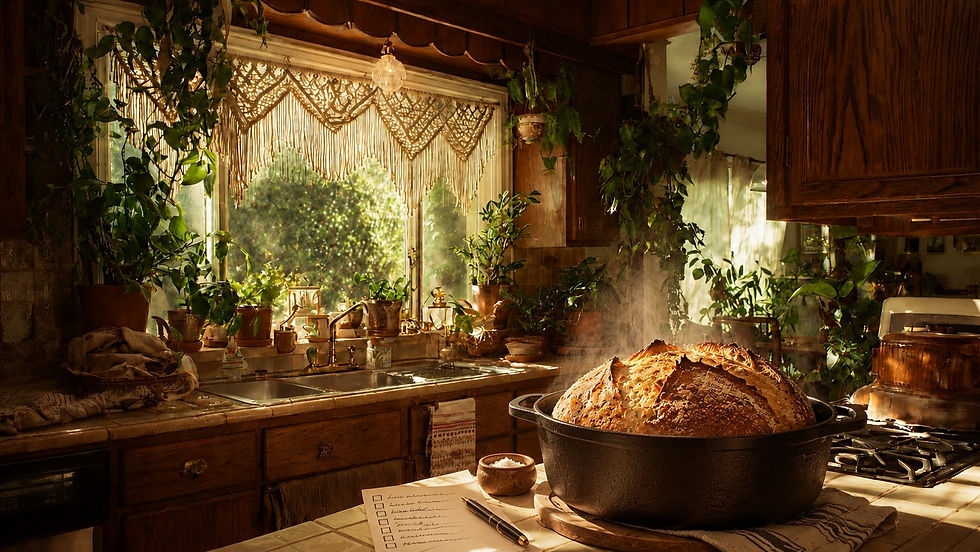
First: you need a starter, and you cannot buy one worth having. Somebody has to give it to you, and that person has to want you to have it. I’m not telling you how I got mine.
If you know a baker, ask. They’ll say yes. They always say yes. It’s the one thing bakers are reliably generous about, and I suspect that’s because it makes more of itself whether they like it or not.
Ingredients
100g active starter (bubbly, and it should smell tart, not like paint)
375g water, warm but not hot
500g bread flour
10g salt
Instructions
Morning. Mix the starter and water in a big bowl. Add the flour. Bring it together with your hands until there’s no dry flour left. It will look like a mistake. It is not a mistake. Cover it, leave it twenty minutes.
Add the salt. Now knead. Ten minutes: heel of the hand, push away, fold over, turn a quarter. Ten. Set a timer, because you will lie to yourself.
Cover the bowl and leave it somewhere warm four to five hours. Every hour or so, wet your hand, reach under one side, stretch it up and fold it over itself. Four times around the bowl. Then leave it alone.
Evening. Tip it out, shape it into a round, and put it seam-side up in a bowl lined with a floured tea towel.
Overnight it goes somewhere warm, and it should roughly double. Cover it properly. I want to be very clear about this part. Cover it properly and weight the cover, or you will wake up at five thirty and find it has gone somewhere on its own.
Morning. Oven to 500°F with a lidded Dutch oven inside for a full thirty minutes. Yes, thirty. The pot has to be genuinely hot or none of this works.
Tip the loaf into the hot pot. Slash the top once, deep, with a very sharp knife. Lid on. Bake 20 minutes.
Lid off, drop to 450°F, another 20 to 25 minutes, until it’s the color of a saddle.
Now the hard part. Let it cool an hour before you cut it. It is still cooking in there. I know. Everybody is in such a hurry.
Mavis’s Notes:
Weigh everything. This is the one recipe where cups will betray you.
If it comes out flat and dense, it rose too long. If it comes out flat and pale, it didn’t rise enough. There is no third kind of flat.
Feed the starter the same day you bake. She has done a lot for you.
Do not knead this the same week you have anything to lift. Anything. Your arms, a coffee cup, the telephone when he calls to ask how it turned out.
Do not make this bread for a man you are trying to impress. Make it for one who has already seen the list.
Makes 1 loaf, or half a loaf if two people eat it standing up at the counter at six in the morning.
Remember: firm, but never cruel.
©2026 Gael MacLean


