
Ding Dong, It’s Art Bell

The thinking is done for you

I should confess something before we go any further: I listened to Art Bell.
Not casually. Not as anthropological fieldwork. I listened because it was genuinely fascinating — the calls from long-haul truckers who’d seen lights over the interstate, the soft-spoken men with theories about underground bases, the whole late-night carnival of American paranoia unspooling across AM radio while the rest of the country slept. I worked on an Area 51 film myself, back when the subject still had the feel of campfire entertainment rather than political infrastructure. I wasn’t a believer. But I was in the room. I heard the doorbell.
And I wasn’t alone in that room. Not by a long way.
I remember visiting a friend on Bainbridge Island — a quiet place, the kind of Pacific Northwest quiet where the trees do most of the talking and the ferry schedule is the closest thing to urgency. It was late. The house was mostly dark. And drifting up from her mother’s kitchen, soft but unmistakable, was the sound of Art Bell’s voice. Her mother was a school teacher. An educated woman. A woman who spent her days helping other people’s children learn to read and reason. And at eleven o’clock at night, alone in her kitchen, she was listening to a man in a trailer in Nevada talk to a caller who claimed to have escaped from Area 51.
I didn’t think she was crazy. I didn’t think she was gullible. I thought: Something is missing.
To understand what Art Bell was, you have to understand what America felt like at the end of the twentieth century for millions of people who weren’t winning. The Cold War was over and we’d been told that meant we won, but the factories were still closing. The malls were still emptying. The small towns were still hollowing out from the inside, one shuttered storefront at a time, and nobody on the evening news seemed to think this was a story worth telling. The official narrative was triumphant. The lived experience was erosion.
Bell didn’t talk about any of that directly. He didn’t have to. What he offered was something more primal: the feeling that the official story wasn’t the whole story. That behind the polished anchors and the measured reassurances and the quarterly earnings reports, there were things happening that nobody in charge wanted you to know about. He never said the government was lying to you, exactly. He just created a space where the question was allowed. Where wondering wasn’t weakness.
And the thing is — he wasn’t entirely wrong. The government had lied. About Vietnam. About Watergate. About Iran-Contra. About what was in the water and what was in the air and what the CIA had been doing in countries most Americans couldn’t find on a map. By the time Bell set up his microphone in Pahrump, the idea that powerful institutions might not be telling you the truth wasn’t paranoia. It was pattern recognition. The problem wasn’t the suspicion. The problem was where the suspicion went when it had nowhere legitimate to land.
Because there was nowhere legitimate. That’s the part that gets lost in the hand-wringing about conspiracy theories. By the 1990s, the institutions that might once have held public skepticism — given it structure, turned it into accountability — were already in decline. Local newspapers were dying. Network news had discovered that opinion was cheaper than investigation. Congress had become a performance. The civic infrastructure that was supposed to catch the doubt and turn it into democratic action was rusting out. And into that vacuum came a calm voice from the Nevada desert, saying: Call me. Tell me what you’ve seen. I’m listening.
Fifteen million people a week took him up on that.
Think about what that number means. Fifteen million Americans, most of them tuning in between ten at night and three in the morning. Truckers in their cabs. Night-shift workers on their breaks. Insomniacs staring at the ceiling. Retirees in small towns where the library had closed and the movie theater had closed and the church was down to Sunday mornings only. These weren’t the fringe. These were the people America had stopped talking to.
Bell gave them two things that nobody else was offering. The first was mystery. Not manufactured mystery, not the slick suspense of a television procedural, but the genuine, unsettling sense that the world was stranger and larger than the version being sold to you on the six o’clock news. UFOs were the headline, but the subtext was permission — permission to feel that your sense of wonder hadn’t been stupid, that your suspicion of authority wasn’t pathological, that the questions you’d stopped asking because nobody around you was asking them were still worth asking.
The second thing was company. Coast to Coast AM was, in the loneliest hours of the American night, a congregation. Not a church — Bell was too smart and too genuinely curious for dogma — but a gathering of people who’d been made to feel, by the culture at large, that their doubts and their wonderings were embarrassing. Bell didn’t tell them what to believe. He told them they weren’t alone. For a school teacher on Bainbridge Island, alone in her kitchen after a long day of being needed by everyone, that might have been enough. Not the content. The company.
Art Bell didn’t kick down America’s door. He rang the bell. He was polite about it. He had a good voice — calm, a little amused, the host of a party you didn’t know you’d been invited to. And for a while, the party was harmless. Strange and wonderful and a little unhinged, the way the best parties are.
But what Bell had accidentally built — a medium, an infrastructure, a loyal audience that trusted a voice coming out of the dark — did not go unnoticed. Because while Bell was building his accidental empire in the Nevada desert, other people had been building a deliberate one for twenty years already. And they had a plan.
I’ve been studying how media shapes belief since I was in film school, which was longer ago than I’d like to admit. You don’t spend a life in documentary work without becoming a student of how images and sounds and framing add up to something that feels like truth whether it is one or not. The sociology of it. The psychology. The way a camera angle or an edit point or a music cue can move a viewer toward a conclusion they think they reached on their own. This is the business. If you don’t understand it, you can’t do the work honestly. And if you do understand it, you can’t help noticing when someone else is using the same tools with worse intentions.
So let me tell you where the right-wing media machine actually started. It didn’t start with Fox News. It didn’t start with Limbaugh. It didn’t even start with Vietnam. It started earlier — in the early sixties, when the networks aimed their cameras at Birmingham and Selma.
What the cameras did to Jim Crow was show it to the rest of the country, in their own homes, in real time. Bull Connor’s police dogs in Birmingham in 1963. Fire hoses turned on schoolchildren. Alabama state troopers on the Edmund Pettus Bridge in Selma in 1965, doing on camera what had been done in the dark for a hundred years. A lot of the viewers seeing this for the first time had spent their lives being told that the Negro problem was a Southern family matter — and now it was in their living room on the six o’clock news, and it was obviously not a family matter, and they were obviously on the wrong side of it. The South lost the picture war before it lost any legal one. And the American right, organizing under Goldwater and hardening through the Nixon years, drew its first great lesson about the press: the gatekeepers had chosen a side, and it was not theirs.
Then came Vietnam. Vietnam was the first war to appear in American living rooms, and it confirmed what the civil rights coverage had already suggested. For the first time in history, an American military campaign was being interpreted in real time by reporters who weren’t reading from a Pentagon press release. Walter Cronkite went to Saigon, saw what was happening, came home, and told the country we were not winning. Lyndon Johnson is quoted as saying, “If I’ve lost Cronkite, I’ve lost Middle America.” Whether or not he said those exact words, he was right. The war was already unpopular; now it was unwinnable, because the narrative had slipped out of the government’s hands. People took the coverage and they took it to the streets. They marched — the civil rights marchers they’d been watching on TV for a decade, joined now by anti-war marchers, and before long it was impossible to tell where one movement ended and the other began. They burned draft cards. They made the war impossible to continue.
The American right watched all of this — Birmingham, Selma, Cronkite, Kent State, both sets of marches, the fall of a sitting president — and drew a single, clarifying lesson. It wasn’t that the war was wrong. It wasn’t that Jim Crow was indefensible. It was that the press had gotten out of line. That an independent news media, left alone to interpret reality for the American public, was an existential threat to conservative power. Never again, they decided, could the gatekeepers of information be trusted to be liberal. The gatekeepers would have to be replaced.
What followed was one of the most sustained, disciplined, and successful long-term strategic projects in American political history. It was Machiavellian in the original sense — not evil, not cartoonish, but coldly realistic about how power actually works. You do not win the culture by winning arguments. You win the culture by capturing the infrastructure that determines which arguments people hear. Think tanks were funded. Talk radio was deregulated. Law schools were quietly colonized. A parallel intellectual ecosystem was built with Scaife money and Coors money and Koch money, piece by piece, over fifty years, while most of the country was watching sitcoms and assuming the adults were in charge.
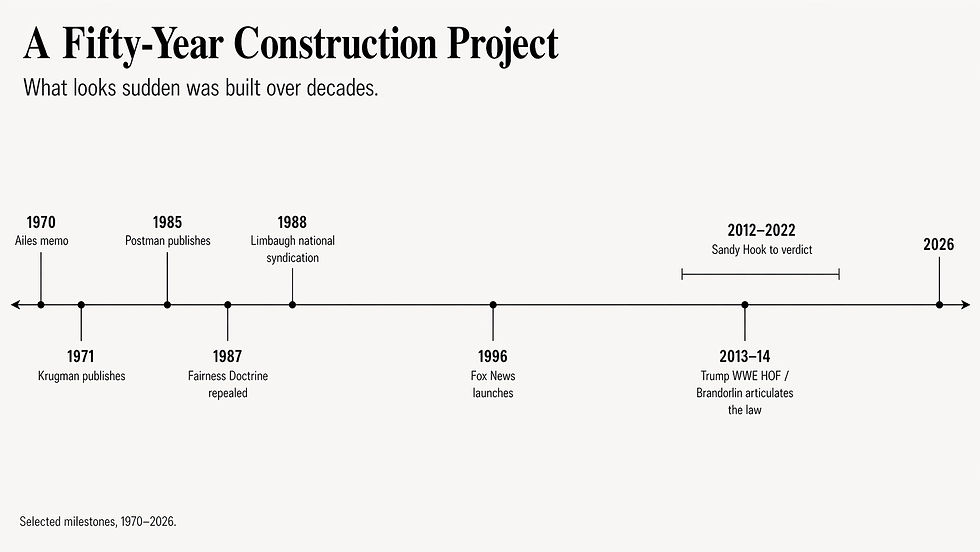
If you want to see the thesis statement of the whole project, it was written down in 1970, in a memo titled “A Plan for Putting the GOP on TV News,” drafted by a young Republican media consultant named Roger Ailes for Richard Nixon’s White House. The memo proposed bypassing what Ailes called the “prejudices of network news” by creating a pro-administration broadcast operation that would feed prepackaged content directly to local television stations. Nixon’s chief of staff, H.R. Haldeman — yes, that Haldeman, the one who went to prison for Watergate — greenlit the idea. The operation was short-lived. The thinking was not.1
Buried in that memo is a sentence that I believe should be carved into the lintel of every journalism school in the country, as both a warning and a confession:
“People are lazy. With television you just sit — watch — listen. The thinking is done for you.”

Read it again. Not just as a strategy, but as a description. Because the word “lazy” is a tell. It’s the word a contemptuous political operative would choose. It’s the condescension bleeding through the page. But what Ailes is actually describing — underneath the contempt — is a well-documented neurological fact, one that had been making its way through advertising research labs for years before he sat down to write the memo.
The brain is a calorie-conserving organ. Sustained critical thought is metabolically expensive — the cognitive-science literature calls it System 2, the slow, effortful, deliberate mode of thinking — and the brain will, given any excuse, fall back into System 1, the fast, automatic, unexamined mode that makes most of your daily decisions without bothering to consult you. This isn’t a character flaw. It’s evolution. A brain that burned full analytical fuel for every stimulus would not have made it off the savannah. Cognitive conservation is how we survived.
What Ailes understood — whether by instinct or by proximity to the research flowing out of labs like Herbert Krugman’s at General Electric — was that television does not merely coexist with this cognitive tendency. It exploits it. Krugman wired viewers to EEG machines in the late 1960s and found that within about thirty seconds of staring at a television screen, subjects shifted from beta-wave dominance — the state of alert, analytical engagement — into alpha-wave dominance, the mode of relaxed, dreamlike reception. The same subjects reading the same content on paper stayed in beta. The screen puts the brain in a kind of trance. The page does not.2
Krugman published these findings in 1971, a year after Ailes wrote his memo. The networks had been using related research to sell dishwashers and breakfast cereal since the mid-sixties. Ailes, steeped in this world as a producer, having worked on The Mike Douglas Show, having already advised Nixon on the televised image that helped him beat Humphrey — Ailes would not have needed a peer-reviewed paper to tell him what he’d been watching work, live, in studio, for a decade. He figured out that the cognitive instrument the advertisers used to sell margarine could be used to sell a political party. All you had to do was understand that “news” and “commercial” were, from the brain’s point of view, the same kind of signal.
This is the part of the story that the standard media-criticism piece misses, because it sounds too soft, too vaguely hippie, too McLuhan. But it’s the whole thing. The fight between a book and a television is not a fight between two delivery systems for the same content. It is a fight between two cognitive states — one active, one passive — and the choice between them is being made for you every time you reach for the remote. The reader builds the world on the page as she goes. The viewer sits in a world that has already been built, and feels the feelings the director wanted her to feel, and calls those feelings her own.
Neil Postman saw it in 1985, in Amusing Ourselves to Death. His argument was that television by its nature — not its content, its nature — degrades public discourse, because it favors entertainment over argument, image over text, instant response over reflection. He used a frame that cuts this whole essay in two: the twentieth century had trained itself to fear the wrong dystopia. Orwell feared a world where books would be banned. Huxley feared a world where nobody would want to read one. Orwell feared a boot stamping on a human face forever. Huxley feared a culture so drowned in entertainment that the boot wouldn’t be necessary.
Ailes built Huxley’s world and sold it to Orwell’s critics.3
That is the trick. That is the whole trick. The right-wing media project has spent fifty years telling its audience that they — the liberals, the coastal elites, the professors, the journalists — are the ones who want to silence you. And while the audience was busy watching for the boot, Ailes’s successors built a medium that made critical thought itself feel like work the audience had been invited to outsource. People are lazy. With television you just sit — watch — listen. The thinking is done for you. That is not a prediction. That is a business model. Huxley would have recognized it at a glance.
This is what I mean by medium as infrastructure. The medium is not the neutral pipe that carries the content. The medium is the content. The medium is the frame, the cadence, the emotional register, the assumption about what kind of person you are for watching it. Ailes understood this intuitively. He understood that if you controlled the frame — the flag in the corner, the news ticker on the bottom, the stern blonde and the powerful jaw — you controlled the emotional logic of what the viewer experienced as information. The facts became optional. The feeling was the point.
Bell’s infrastructure was accidental. He built a late-night confessional for American wondering and stumbled into an audience of millions. Ailes’s infrastructure was deliberate. It had a strategic plan, a fifty-year timeline, and a billion dollars in conservative foundation money behind it. Bell offered permission to wonder. Limbaugh, when his turn came, offered permission to resent. Fox offered permission to hate. And the algorithm, when its turn came, offered permission to never again encounter a contrary fact, a dissenting neighbor, or a moment of productive doubt.
Each step lowered the bar on what the audience was allowed to feel without apology. Each step was built on the infrastructure the previous one had laid. And each step required, as a precondition, an audience whose capacity to evaluate what they were being told had already been quietly, methodically degraded.
Which brings us to the schools.
What happened to American public education over the last forty years is the longest, quietest con in the country’s history. And it wasn’t unrelated to what was happening in the studios and on the airwaves. It was the ground game.
Civics used to be a required course. Not a good course, necessarily. Not always an inspiring one. But it existed, and its existence carried an implicit promise: that the country expected you to understand how it worked. How a bill became law. What the First Amendment actually said. Why the separation of powers mattered, and to whom. The expectation wasn’t that every kid would become a constitutional scholar. The expectation was that every kid would leave school with the basic operating manual.
That expectation is gone. By 2022, only about one in five eighth graders scored proficient in civics on the National Assessment of Educational Progress. Four out of five American thirteen-year-olds could not demonstrate a basic understanding of how their own government functions.4 This is not because children got stupider. It’s because the course got cut, the funding got slashed, and the whole concept of civic education got quietly reclassified from “essential” to “elective” to “expendable.”
But here’s the part that should keep you up at night. It wasn’t just the teaching that was gutted. It was the measurement. A federal study mapping state proficiency standards onto the NAEP scale found that in 2022, the vast majority of states had set their own “proficient” standard at a level that only corresponded to NAEP Basic — the lowest passing tier on the national benchmark. In grade 4 reading, only six out of fifty states had standards that actually reached NAEP Proficient. In grade 8 reading, the same: six out of fifty. And in 2013, more than half the states — twenty-six of them — had grade 4 reading standards that fell below even NAEP Basic. Below the floor.5
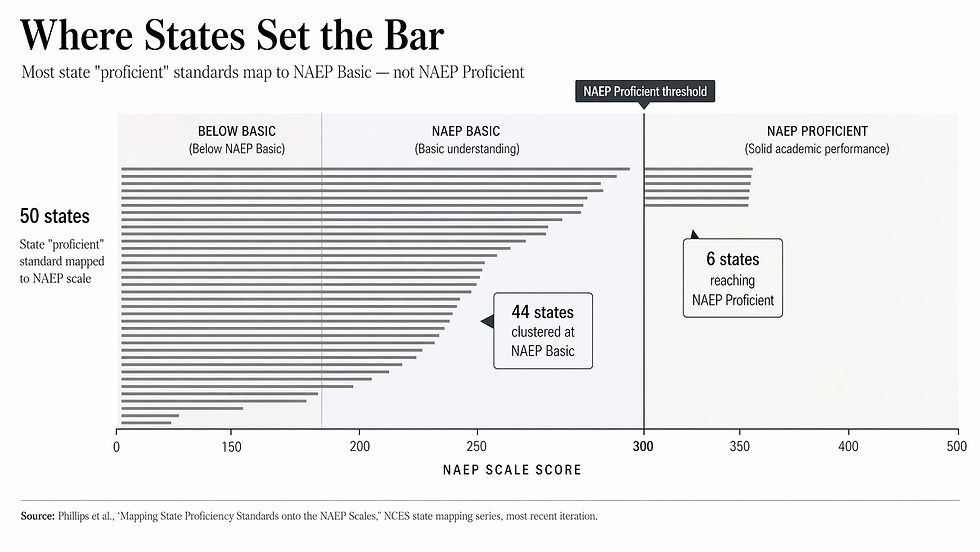
The states weren’t just failing to teach children how to think. They were redefining what “good enough” meant so that the failure wouldn’t show. A kid could be reading below the most basic national standard and still go home with a report card that said “proficient.” The parents would see the word and believe it. The school would report the number and count it. And nobody — not the kid, not the parent, not the legislator who cut the budget — would have any reason to ask whether the word on the page meant what they thought it meant.
This is not a side effect. This is the architecture of a con. You don’t just strip people of the tools to evaluate what they’re hearing. You strip them of the ability to know the tools are missing.
Follow the money and you’ll find the motive. Public schools run on property taxes and state budgets, which means they are permanently at the mercy of legislators who have to choose between teacher salaries and tax cuts. For forty years, the tax cuts won. Not always loudly. Sometimes it was just a freeze here, a consolidation there, the quiet elimination of a position that doesn’t get refilled. The art teacher retires. The librarian becomes part-time. The civics requirement becomes a social studies elective becomes a semester becomes nothing.
What replaced it was standardized testing — a system that measures, with great precision, a student’s ability to select the correct answer from four options provided. Not to formulate a question. Not to evaluate a source. Not to distinguish between an argument and an assertion. Just: A, B, C, or D. We replaced “how to think” with “what to answer,” and we did it so gradually that by the time anyone noticed, we’d raised an entire generation that had been trained, from age six, to perform the exact cognitive operation that propaganda requires: receive a claim, select from available options, move on. Don’t linger. Don’t ask who wrote the options.
People are lazy. With television you just sit — watch — listen. The thinking is done for you.
Ailes wrote that in 1970. The educational system — the one that was simultaneously being hollowed out of civic instruction and narrowed into multiple-choice conditioning — spent the next fifty years quietly producing the exact viewer the memo described. Understand what this means. The fight between an educated citizenry and a captured media ecosystem is not a fair fight under any circumstances — the machine always had more money and more time. But it is an unwinnable fight if the citizenry has been trained, from age six, into the exact cognitive posture the captured medium requires. The schools were not running parallel to the media project. The schools — in their long slow surrender to bubble-sheet conditioning and the quiet euthanasia of civics — were the media project’s ground-level preparation. By the time a Fox graphic was on the screen, the audience had been thirty years in rehearsal for it.
And remember the school teacher on Bainbridge Island, listening to Art Bell in her kitchen. She could teach her students to read. She could walk them through a textbook. But could she teach them to wonder? Could she teach them to sit with uncertainty, to hold a question without reaching for the nearest answer, to tolerate not knowing? Not if the curriculum didn’t ask for it. Not if the test didn’t measure it. Not if the whole system was designed, from the top down, to produce people who could fill in bubbles and move on.
Art Bell didn’t create that audience. He found it. And after Bell, they were coming for it.
Rush Limbaugh was the second man through the door, and he wasn’t nearly as polite about the bell. If Bell gave his audience permission to wonder, Limbaugh gave them permission to resent. He understood something that Bell, for all his showmanship, had never really exploited: the audience wasn’t just suspicious of the official story. They were angry. They felt left behind, talked down to, corrected by people they didn’t respect, and they wanted someone who would tell them that their resentment was righteous. Limbaugh gave them that, three hours a day, five days a week, for thirty years.
None of this was accidental either. The 1987 repeal of the Fairness Doctrine — a Reagan-era deregulatory gift to conservative broadcasting — was the infrastructure move that made Limbaugh possible. Before 1987, a broadcaster using the public airwaves had a legal obligation to present contrasting viewpoints on controversial issues. After 1987, they didn’t. Within two years, Limbaugh’s show was nationally syndicated. Within a decade, conservative talk radio was a billion-dollar industry that blanketed the AM dial from coast to coast. Deregulation created the vacuum. Limbaugh filled it. And the audience that had been primed by Bell to wonder about the official story was now trained, by Limbaugh, to despise the people telling it.
The genius of the format — and it was genius, in the way that a virus is genius — was that it looked like information. It had the cadence of news. Limbaugh sat behind a microphone, referenced current events, cited statistics (selectively, creatively, sometimes fictionally), and delivered it all with the authority of a man who had done the reading you hadn’t. He hadn’t, of course. But how would you know? Who taught you to check?
Then Fox News arrived in 1996, and Roger Ailes finally got to build the thing he had sketched on a napkin for Nixon twenty-six years earlier. Murdoch had the money. Cable had removed the last regulatory obstacles. And Ailes, now in his prime, understood television the way a poker player understands tells. He knew that if you put the American flag in the corner of the screen and a powerful jaw behind the desk and you ran a news ticker along the bottom, you could say almost anything and it would register as news. The frame was the message. The content was negotiable.
If Bell gave permission to wonder and Limbaugh gave permission to resent, Fox gave permission to hate. To hate your neighbor. To hate the teacher. To hate the scientist. To hate the journalist. To hate anyone who might, in some other life, have been the person who taught you to ask the next question. Fox didn’t just offer a different version of the news. It offered a new identity — an embattled, righteous, persecuted identity — and the price of admission was agreeing, on a deep and permanent level, that the people who disagreed with you were not just wrong but enemies.
And it worked. Not because Ailes was a mastermind — though he was — but because the audience had already been sorted. Thirty years of gutted schools had produced viewers who could not, in meaningful numbers, distinguish between reporting and commentary, between sourced journalism and a man with an opinion and a powerful jaw. They had never been taught the difference. Why would they see it now?
The frogs were never gay. Alex Jones knew that. His audience knew that, on some level — the level where you know the wrestling isn’t real but you watch it anyway, because the storyline feels true, because it confirms something you already suspected about the people in charge, because the performance of outrage is more satisfying than the tedium of actual civic engagement.
The conventional take on Alex Jones is that he’s a liar who lies. That he stood in front of a microphone and said the chemicals in the water were turning the friggin’ frogs gay, and that this was a false claim, and that the people who believed it were fools. This is the standard line in every profile, every documentary, every late-night segment. It is comforting. It is flattering to the profile writer. And it is, I think, completely wrong about what Alex Jones actually does for a living.
The man who revealed what Jones actually does is a former employee of his named Josh Owens. Owens spent four years inside Infowars — from 2013 to 2017, right through the rise of Trump — as a video editor and field producer. He went on the road. He staged the footage. At one point he dressed a colleague as an ISIS operative and filmed him crossing what was supposed to be the Rio Grande but was actually, Owens later admitted, “a little stream that looked like it could be.”6 Owens is in the room on a lot of the worst of it. And he wrote a book about it, The Madness of Believing, that does something the standard profiles don’t. It describes the machine from the inside.7
Two of Owens’s observations are, I think, the key to the whole thing.
The first:
“I think you could probably hook Jones up to a lie-detector test, and he would pass it. I don’t think he cares what the truth is. So I think it frees him up, in some sense, to sort of say whatever he feels is of value to him in any given moment.” 8
Read that carefully. Owens is not describing a liar. A liar is a person who knows the truth and is misrepresenting it on purpose. Jones, in Owens’s account, has exited the truth/falsehood framework entirely. He is not tracking the real thing against his representation of it, because there is no real thing to track against. There is only what lands. Whatever produces the desired charge in the room becomes, for the duration of the segment, operationally true. And because he isn’t maintaining a dual ledger — one for what’s actually happening, one for what he’s saying about it — the strain that catches most liars never catches him. He could pass the polygraph. He believes the thing he’s saying, in the only sense of “believe” that his internal system still recognizes. It’s the sense in which a professional wrestler believes he hates his opponent, for the three minutes that the match requires.
The second observation is the one that should stop you cold:
“Jones was not sitting there telling us to lie about things. He was making us question our own minds. After years in that environment, you stop even believing the fire alarms that are going off in your brain saying, like, This is insane. This is crazy. This is wrong. And you think, Maybe there’s something else that I’m not seeing.” 9
That is not the testimony of a man describing a newsroom. That is the testimony of a cult defector.
And once you see it, the whole Jones operation falls into a different category. He is not a propagandist in the traditional sense. He is running a technique that the psychiatrist Robert Jay Lifton catalogued in 1961, when he interviewed survivors of Mao’s thought-reform camps — the “re-education” centers the Chinese Communist Party used to break and remake the beliefs of Western prisoners and Chinese intellectuals in the early 1950s. Lifton identified eight characteristics of totalist thought reform, and one of them — the one that maps Jones onto cult operator with unsettling precision — Lifton called mystical manipulation. The deliberate destabilization of the target’s trust in their own perception, until the only stable reference point left in their world is the leader’s voice.10
You do this by generating experiences that appear spontaneous but are actually engineered. You do it by insisting that ordinary events have hidden significance only the initiated can see. You do it by reacting to every attempt at disagreement as evidence of the disagreer’s compromise or corruption. You do it by making it emotionally costlier to trust your own judgment than to defer. And you do it, most of all, by never letting the target settle — by keeping the ground moving under their feet, by contradicting yesterday’s revelation with today’s, by demanding adaptation faster than reflection can catch up. The target stops running on his own operating system and starts running on yours. The fire alarm in his brain — the one that says this is insane, this is crazy, this is wrong — is still functional. He just stops trusting it. He assumes he must be missing something. He assumes you must see something he doesn’t.
This is the mechanism Owens lived inside for four years. It is a cult mechanism. It is not a rhetorical mechanism. The distinction matters, because it tells you why fact-checking Alex Jones has never worked and was never going to work. You can’t refute a claim that was never meant to be evaluated. The claim was meant to destabilize, and it did its work the moment it was uttered. By the time the Reuters correction arrived, the audience had moved on to the next destabilization, and the next, and the next. The claim wasn’t the product. The vertigo was.
Which reframes Sandy Hook completely.
When Alex Jones said, on his program, in 2012 and repeatedly for years after, that the elementary-school massacre in Newtown, Connecticut had been a false-flag operation, and that the grieving parents of the murdered children were crisis actors, the reflexive question — did his audience believe him? — is the wrong question. It’s the question a journalist asks. Jones wasn’t in the journalism business.
He wasn’t trying to convince his audience that Sandy Hook was fake. He was trying to convince them that reality itself was no longer something they could check for themselves. If Sandy Hook might be staged, anything might be staged. If those parents might be actors, any parent might be an actor. If the most vivid, documented, locally-reported atrocity on American soil in a generation might be a hoax, then there is no event — none — that is safe from the same suspicion. And once you live inside that suspicion, the only reliable reference point you have left is the person who keeps telling you to suspect. Which is Jones. Which is always, by design, Jones.
This is the same move that cults use to sever a new recruit from his family. Dad says the compound is dangerous? Well, Dad has been wrong about other things. How do you know what Dad is really up to? Maybe there’s something else you’re not seeing. Once the recruit’s trust in his own people is broken, the cult doesn’t have to lock the doors. The locks are inside his head. And this is worth saying clearly, because the movie version of cult recruitment features desperate, gullible people — and the reality is the exact opposite. Cults don’t target the stupid. They target the searching. The intelligent, thoughtful, unsatisfied person who is still looking for meaning in a culture that has stopped offering any is precisely the person the mechanism works on. It’s why your balanced, bright friends end up inside. The machine is calibrated for them.
The Sandy Hook parents understood this. That’s why they sued. They weren’t suing for the lies, exactly. They were suing for the use of their dead children as raw material in an operation that was designed to unmoor a million people from their ability to believe their own eyes. And when a Connecticut jury, in 2022, and a Texas jury the same year, ordered Jones to pay the Sandy Hook families something on the order of a billion and a half dollars in damages, they were doing something that no fact-check and no documentary had ever quite managed.11 They were naming the machine.
It had taken ten years.

Here is where it gets uncomfortable for everyone, and where I lose some of you, and that’s fine.
The remote was always on the coffee table.
I know this because I was holding one. I listened to Art Bell in the dark, and I found it fascinating, and I never once mistook it for the news. I worked on a film about Area 51, and I knew the difference between a good story and a factual claim. Not because I’m smarter than anyone — I’m not — but because somewhere along the way, someone taught me to ask the next question. To wonder who benefits from the story. To notice when entertainment starts wearing the clothes of information and hasn’t earned them.
It is true that the system failed. That the schools were gutted, the civic infrastructure hollowed out, that an entire media ecosystem was constructed — deliberately, strategically, over half a century — to exploit the gap. All of that is true, and all of that is damning, and none of it fully explains why millions of adults exposed to the same information environment made different choices. Some people raised in the same defunded schools, watching the same television, living in the same zip codes — changed the channel. Read a book. Asked a question. Wondered, even once, whether the man on the screen might be lying.
The comfortable version of this story has clean villains: Rupert Murdoch, the Koch brothers, the algorithm, and yes, Roger Ailes with his fifty-year blueprint. And they deserve every syllable of blame they get. But the uncomfortable version — the one that actually explains the country we’re living in now — has to account for the viewer who chose, night after night, year after year, to sit in the blue glow and let it happen. Who found the lie more comfortable than the news because the lie told them what they already wanted to hear.
And now we have to talk about why that remote was so heavy.
The Italian programmer Alberto Brandolini — in a fit of frustration during an online argument in 2013 — wrote down what became known as Brandolini’s Law, also called the bullshit asymmetry principle: the amount of energy needed to refute bullshit is an order of magnitude larger than is required to produce it. Say it takes you twenty seconds to generate a false claim about the election. It will take a fact-checker an hour to gather sources, write the correction, and publish it. Producing the false claim required no sources and took a single tweet. Refuting it requires research, editing, legal review, publication, and then — this is the killer — distribution through a medium the original audience doesn’t read. The lie travels free. The correction travels in coach, if it travels at all.12
The Ailes machine didn’t invent this asymmetry. Brandolini didn’t either. The asymmetry is baked into the physics of information: a plausible lie is cheap, an established truth is expensive. But what the machine did — deliberately, over fifty years — was industrialize the cheap side while the gutted schools and the dying newspapers were hollowing out the expensive side. That is a structural victory. It is why the loudest, simplest, most satisfying version of any claim is the one that wins the afternoon, no matter what is true. It is why repetition works. It is why a man can tell a documented lie in the morning and be boosted by algorithm into fifteen million phones by dinner, while the correction — if a correction even exists — reaches only the audience that was already skeptical.
Now combine that structural asymmetry with two things your existing media diet has done to you, whether or not you chose them, whether or not you can see them.
First: the wrestling problem. I said earlier that Jones’s audience knew, on some level, that the frogs weren’t gay. That is true. But the level on which they knew it is the level on which wrestling fans know that wrestling is staged. The term inside the business for this collaborative fiction — the agreement between performer and audience to treat the staged thing as if it were real, for the duration of the performance — is kayfabe. Kayfabe is older than television. Kayfabe is why a sold-out crowd in 1987 could boo Hulk Hogan’s heel turn as if they’d been personally betrayed, and then go home and explain to their kids that the whole thing was scripted. The scripting was not a bug. The scripting was the point. The crowd enjoyed the bout precisely because they were in on it — because booing the villain is more fun when the villain is cooperating with the boos.
This matters because Donald Trump is a literal WWE Hall of Famer — inducted in 2013 — and the rise of kayfabe politics is not a metaphor.13 It is a direct pipeline. His rallies are wrestling shows with better catering. The insults have heel-turn cadence. The crowd chants the agreed-upon chants. The reporter penned at the back is the designated foil. When the fact-checker runs out to point out that the claim he just made is factually untrue, the fact-checker is not experienced by the crowd as a defender of the truth. The fact-checker is experienced as an interloper who doesn’t understand the form. He’s breaking kayfabe. The boo that follows is not evidence that the crowd doesn’t know the difference between performance and reality. The boo is evidence that the crowd prefers the performance and resents the attempt to replace it with something duller.
This is a harder, less flattering insight than “they’ve been brainwashed.” It explains things brainwashing doesn’t — like why fact-checks backfire, and why every attempt to correct the record is received as an insult to the crowd rather than a service to the truth. Kayfabe can be broken, but it cannot be corrected. The only way out of kayfabe is to stop enjoying it. Which is a much taller order than being handed a PolitiFact article.
And second: the parasocial problem. That school teacher on Bainbridge Island, alone in her kitchen with Art Bell’s voice drifting up from the radio — what she was experiencing, in the technical language of media psychology, was a parasocial bond. A one-sided relationship, unreciprocated but emotionally real, between a listener and a voice she will never meet. Donald Horton and Richard Wohl named this phenomenon in a 1956 paper in the journal Psychiatry — they saw it in 1950s television viewers and their on-screen personalities — and they saw, correctly, that it does not feel, from the inside, like consumption. It feels like friendship.14
Fifteen million people, most of them alone, tuning in to Art Bell between ten at night and three in the morning, were not watching a program. They were spending time with a friend. A friend who did not judge them, did not correct them, did not demand anything of them, and did not leave. That friend, for many of them, was the most reliable companion they had. Which is its own comment on late-twentieth-century American loneliness, but it is also the missing piece of the why-won’t-they-change-the-channel question.
Because changing the channel is not, in parasocial terms, changing the channel. It’s ghosting a friend. It’s ending a relationship. It’s telling someone who has been there for you, every weeknight, in the loneliest hour of your day, that you don’t want to hear from them anymore. The remote is heavy because what it turns off is not a show. It’s a presence. And the presence has a name, and it sounds like it cares about you, and it’s hard — maybe for some people impossible — to betray a voice that has never, not once, asked anything of you except your attention.
This is the lock-in. Not brainwashing. Not stupidity. Loyalty, in the deep sense, to a voice that has been in the room for twenty years. You don’t turn off Hannity. You don’t turn off Carlson. You don’t turn off Rogan. They’re not programs. They’re people you have coffee with every morning, alone. The asymmetry of effort is real. The kayfabe is satisfying. But underneath both of those, there’s the parasocial bond, and it’s the thing most of the political-correction industry has consistently failed to take seriously. You cannot argue people out of a friendship with a commentary on the friend’s voting record.
So when I say the remote was always on the coffee table, I have to say it with the knowledge that the remote was not weightless. There were reasons — structural, cognitive, emotional, commercial — that it took more energy than the average viewer was primed to spend. Brandolini’s asymmetry made the correction expensive. Kayfabe made the correction unwelcome. The parasocial bond made the correction feel like a betrayal.
Ailes knew all of this. Or if he didn’t know it by name, he knew it by instinct. People are lazy. With television you just sit — watch — listen. The thinking is done for you. The word “lazy” was still wrong. It still is. People aren’t lazy. People are tired. People are lonely. People are frightened. People are running on an underfunded cognitive budget that the propagandist has spent fifty years tightening. People reached for the remote to turn on the friend, because a friend was what they needed, and there wasn’t a better one available.
This is what propaganda does. Not at the point of entry — any halfway-decent education system could have built resistance to that. Propaganda does its real work at the point of repetition, where the lie becomes familiar, and the familiar becomes true, and the true becomes identity. By the time you’re arguing with your uncle at Thanksgiving about whether the election was stolen, you’re not arguing about evidence. You’re arguing about who he is. And people will burn down every epistemological structure they have before they’ll let you tell them they are not who they think they are.
Art Bell rang the doorbell. Rush Limbaugh walked in. Fox News redecorated. Alex Jones ran the cult-destabilization protocol from the basement studio. The algorithm moved in upstairs. And somewhere in there, the remote control became a loyalty test — changing the channel was not an act of critical thinking but an act of betrayal. Of your tribe. Of your identity. Of the voice that had been in your kitchen for twenty years, and that you had come, in the only sense of the word that mattered, to love.

The problem isn’t that people believe crazy things. People have always believed crazy things. The problem is that we dismantled every institutional mechanism that once helped people distinguish between the crazy things and the real ones — and then we built a billion-dollar industry on the rubble. We let the states rewrite the definition of “proficient” until it meant nothing. We let the budget cuts strip out every course that taught a kid to ask “who says?” and “why?” We let a fifty-year strategic project capture the infrastructure of American attention while most of us were busy living our lives. We did this over decades, slowly enough that it never made the front page, and then we acted surprised when the front page stopped mattering.
Somewhere tonight, in a kitchen not so different from the one on Bainbridge Island, someone is listening to something. Not Art Bell — he’s been dead since 2018. But his heirs are legion, and they are no longer polite, and they are no longer interested in UFOs. The voice coming through the speaker now doesn’t ask you to wonder. It tells you to be afraid. It tells you who to blame. It tells you that the people trying to help you are the enemy and the man who is lying to you is the only one telling the truth. The thinking is being done for you, exactly as Roger Ailes promised Richard Nixon it would be, fifty-six years ago, in a memo nobody was supposed to read.
This is the part where I’m supposed to step back into the measured voice and offer you a balanced conclusion. I’m not going to do that. But I’m also not going to do the other thing — the one you’re expecting me to do, the rising-voice list of everything the captured media environment has cost us. The agencies gutted. The allies insulted. The neighbors turned into strangers. The tax policy arranged to look like a grievance instead of a theft. I could write that paragraph. You’ve been trained for fifty years to feel it. You would feel exactly what I wanted you to feel, and you would move on.
That is the trap. An honest essay about propaganda cannot end in propaganda. Even good propaganda. Especially good propaganda. The whole argument of these pages is that the instrument that makes a reader feel rather than think is the instrument that built the country we are living in now, and I am not going to pick it up for the last stretch just because the stakes are real. The stakes are real. They are not my job, in these last paragraphs, to reinforce with adjectives. They are yours to find, slowly, by doing the thing this essay has been about. Figure it out.
So here is what I’m actually asking. Not because it will move you. Because it is the thing.
I’m not asking you to become an activist. I’m not asking you to march. I’m asking you to do the smallest, most dangerous thing a citizen can do in a captured information environment: change the source. And change the medium. Read something that makes you uncomfortable — not watch, read. The difference matters more than you think. The screen puts you in the state the propagandist needs you in. The page does not. Seek out the reporter, not the commentator. Find the person who shows you the receipts instead of the person who tells you how to feel. It will not be entertaining. It will not be comforting. The truth tastes like medicine because medicine is what you need when you’re sick, and this country is sick.
That’s the ask. Smaller than the hour seems to deserve. The only one that actually reaches the thing that’s broken.
Art Bell rang the doorbell a long time ago. The party that followed was fun for a while. But the guests who came after him aren’t here for the conversation. They’re here for the silverware. And they are counting, every single night, on you not noticing.
Pick up the remote. Change the channel. Better yet, pick up a book.
Because someone is ringing the doorbell again. And this time, it’s not Art Bell.
Ding dong.
Notes
1. “A Plan for Putting the GOP on TV News” (1970), unsigned memo from the Haldeman files, Richard Nixon Presidential Library. The document was unearthed by John Cook and published in full via Gawker, June 30, 2011, as part of a 318-page cache of Ailes’s White House consulting files; its strategic arc is traced at length in Gabriel Sherman, The Loudest Voice in the Room: How the Brilliant, Bombastic Roger Ailes Built Fox News (Random House, 2014).
2. Herbert E. Krugman, “Brain Wave Measures of Media Involvement,” Journal of Advertising Research 11, no. 1 (February 1971): 3–9. Krugman was manager of corporate public-opinion research at General Electric. Subsequent neuroscience has complicated the straightforward “alpha = passive, beta = active” reading of his findings, but the broader claim that screen viewing and page reading elicit meaningfully different cognitive states has been repeatedly replicated.
3. Neil Postman, Amusing Ourselves to Death: Public Discourse in the Age of Show Business (Viking, 1985). The Orwell/Huxley frame opens the foreword and recurs throughout; Postman argues that twentieth-century critics were watching for the wrong dystopia.
4. “The Nation’s Report Card: Civics 2022,” National Assessment of Educational Progress, National Center for Education Statistics. Twenty-two percent of eighth graders scored at or above NAEP Proficient, down from twenty-four percent in 2018.
5. Gary W. Phillips et al., “Mapping State Proficiency Standards onto the NAEP Scales,” National Center for Education Statistics. The most recent iteration of this study maps state cut scores onto NAEP levels and consistently finds that most state “proficient” thresholds correspond only to NAEP Basic.
6. Josh Owens, interview with Dave Davies, “Former Infowars employee on Alex Jones’ conspiracy machine,” Fresh Air, NPR, March 30, 2026.
7. Josh Owens, The Madness of Believing: A Memoir from Inside Alex Jones’s Conspiracy Machine (Grand Central Publishing, 2026).
8. Josh Owens, interview with Charlie Warzel, “Breaking Free from Alex Jones,” Galaxy Brain (podcast), The Atlantic, April 2026. https://www.theatlantic.com/podcasts/2026/04/breaking-free-from-alex-jones/686842/
9. Owens, in the Atlantic Galaxy Brain interview cited above and in related material published around the book’s April 2026 release; compatible formulations appear in the book itself.
10. Robert Jay Lifton, Thought Reform and the Psychology of Totalism: A Study of “Brainwashing” in China (W. W. Norton, 1961). “Mystical manipulation” is one of the eight criteria of totalism Lifton enumerates in the closing chapter; the others include milieu control, the demand for purity, the cult of confession, “sacred science,” loading the language, doctrine over person, and the dispensing of existence.
11. Lafferty v. Jones, Connecticut Superior Court (October 2022): $965 million in compensatory damages, followed by approximately $473 million in punitive damages. Heslin and Lewis v. Jones, Texas District Court (August 2022): approximately $49 million in combined compensatory and punitive damages. Combined judgments in the neighborhood of $1.5 billion. Jones subsequently filed for Chapter 11 bankruptcy.
12. Alberto Brandolini, originally articulated on Twitter in early 2013 and later developed in his XP2014 keynote, “The Bullshit Asymmetry.” The principle is sometimes rendered as “the amount of energy necessary to refute bullshit is an order of magnitude bigger than to produce it.”
13. Donald J. Trump was inducted into the WWE Hall of Fame (Celebrity Wing) by Vince McMahon on March 30, 2013, at Madison Square Garden, recognizing his participation in the “Battle of the Billionaires” match at WrestleMania 23 (2007).
14. Donald Horton and R. Richard Wohl, “Mass Communication and Para-Social Interaction: Observations on Intimacy at a Distance,” Psychiatry 19, no. 3 (1956): 215–229. The paper introduced the term “parasocial” and predicted, with striking accuracy, the emotional dynamics of audience-to-media relationships that would come to define the later twentieth and early twenty-first centuries.
© 2026 Gael MacLean


