
The Gaze

Notes on freaks, aristocrats, and who’s really looking

The Forms
There are seven hundred and thirty-eight of them this year. Bills. Introduced across forty-two states and the federal government, each one a small machine designed to do a specific thing: make someone disappear.
Not literally. Legally. Linguistically. The way you make a person vanish is not with violence. Not at first. First you change the language. You redefine sex across an entire state legal code. You invalidate a driver’s license. You strip a passport marker. You pass a bill that says a person’s experience of their own body is a felony, punishable by imprisonment not exceeding life.
Life. For being alive in the wrong category.
I’ve been reading these bills the way I used to read scripts: for structure, for subtext, for what’s not on the page. And what’s not on the page is the person. The bills don’t mention people. They mention definitions. Classifications. Regulatory frameworks for the management of bodies that refuse to conform to the taxonomy the state requires.
This is an old machine. We’ve seen it before. The forms change—yellow stars, identity cards, census questions about religion or tribe—but the mechanism is the same. First you name them. Then you separate them. Then you can do whatever you want to them, because them is a category, not a person.
But I’m not here to write about legislation. Not exactly. I’m here because of something older and stranger. The question of what happens when you look, really look, at someone the culture has decided is a freak. What happens to the person being seen. What happens to the person seeing. And what happens when the culture discovers that the looking itself is the act it cannot tolerate.
The Aristocrats
Diane Arbus called them aristocrats.
Not with irony. Not with the protective distance of metaphor. She meant it the way you mean something you’ve spent years arriving at. Freaks, she said, had already passed their test in life. They didn’t have to go through life dreading what might happen to them. It had already happened. They were born with their trauma. And that made them, in her eyes, a kind of nobility.
This was New York, late 1950s into the ’70s. Arbus had left her husband, left the fashion photography business they’d built together. All those pages in Vogue and Glamour that both of them hated. And moved to Greenwich Village with a camera and a hunger for what she called “the divineness in ordinary things.” But ordinary wasn’t what she found. Or rather, she found that ordinary was a lie. That the suburban family on their lawn in Westchester was just as strange, just as constructed, just as performing as the sword swallower at Hubert’s Museum on 42nd Street.
She photographed everyone with the same Rolleiflex, the same square format, the same head-on gaze. A giant in his parents’ living room. Identical twins in matching corduroy. A young man at a pro-war rally, his face contorted around a button that says I’m Proud. A retired man and his wife in a nudist camp, standing on their front lawn as if posing for a holiday card. Transvestites in their dressing rooms. Children in Central Park. A boy with a toy hand grenade, his face twisted into an expression that could be rage or ecstasy, and the camera not deciding for you which.
No lens angle to heroicize. No lens angle to diminish. Eye level. Every time.
I didn’t encounter Arbus until my twenties. It was the twin girls in matching dresses. I stood in front of that photograph for a long time, not understanding why it had stopped me, and then I understood: it wasn’t the strangeness. It was the stillness. The absolute refusal to apologize for being looked at. Those two girls staring back through the frame with the patience of people who’d been stared at their whole lives and had decided, without discussion, that they would simply outlast the staring. I thought: this is what I’ve been looking for. I just didn’t know it had a name.
The form itself was the argument: there is no line between inside and outside. There are only people, performing the self they’ve constructed or been assigned, staring back at you through the photograph with a calm that dares you to look away.
The Carnival of Sights
Twenty-four years after Arbus’s death, a woman from Jamestown, New York, walked the streets of Manhattan with a Leica M3, photographing strangers in black and white.
The woman was Natalie Merchant. The occasion was a music video. The song was “Carnival.”
Merchant had first visited New York at sixteen, a rural kid dropped into a city that operated on a frequency she had no equipment to receive. The streets were a carnival of sights to see. Actors, thrill seekers, vendors, wild-eyed mystic prophets raving about salvation on traffic islands. She was, by her own account, hypnotized. Mesmerized. Overwhelmed by lives that made no sense inside the categories she’d brought with her from upstate.
I know that feeling. I know it in my body. The hunger for color, for depth, for anything that hasn’t been sanded down to the approved frequency of pleasantness. Merchant went to New York and found it on the streets. I went looking for it with a camera.
She went home and wrote a song about it. About the gaze—her gaze—and what it cost her to discover she had one.
Have I been blind? Have I been lost inside myself and my own mind? Hypnotized, mesmerized, by what my eyes have seen?
I heard “Carnival” for the first time driving through the kind of suburb Merchant had left behind. I pulled over. The melody was beautiful. That wasn’t why. Someone had finally named the thing I’d been carrying since I was old enough to notice that the world I’d been given was the performance, and the world I’d gone looking for was the real one. Merchant wasn’t singing about New York. She was singing about the moment you realize your gaze has a cost.
This is the question Arbus never asked aloud but lived inside for thirteen years until it killed her. The question of whether seeing is an act of communion or consumption. Whether the camera—or the eye, or the legislative pen—takes something from the person it frames, or whether framing is the only form of attention most people will ever receive.
In the video, Merchant performs Arbus without naming her. The black-and-white streets. The Leica. The direct gaze at people who don’t know they’re being seen. Or who know exactly, and look back anyway. The video was directed by Melodie McDaniel, a photographer herself, and every frame is composed with the angular shadows and careful juxtapositions of street photography. It is four and a half minutes of a woman learning what her eyes do to the world.
But the video is the radio edit. The album version runs six minutes, and those six minutes matter. The song opens with a near-minute of percussion and electric guitar—Jennifer Turner’s restless, spiraling lines over a drumbeat that sounds like walking, like feet on pavement, like the rhythmic accumulation of seeing. When Merchant’s voice finally enters, it arrives low, almost conversational, describing what she saw the way you’d describe it to a friend over coffee. The streets. The actors. The carnival. But the song doesn’t stay conversational. It builds. The arrangement thickens. The key holds in F-sharp minor—a key that lives in the body, in the chest, that hums with unresolved tension. And by the outro, Merchant is no longer describing. She is asking, and asking, and asking—the same questions, layered over each other, the voice climbing, the words overlapping: “Have I been blind, have I been lost, have I been wrong, have I been wise, have I been strong—have I been?” The song doesn’t end. It wears itself out. It asks until asking is all that’s left.
Here is where Merchant parts company with Arbus. Where Arbus turned the camera outward and never stopped, Merchant turns it inward. The song’s power is not in what she sees. It’s in her reckoning with the seeing.
Have I been wrong? Have I been wise, to shut my eyes and play along?
Shut my eyes. Play along. These are not the words of a spectator. They are the words of someone who has realized that spectatorship is a form of complicity. That to watch the carnival without entering it is to participate in the machinery that makes the carnival necessary.
The Dust Bowl Gospel
In 2003, Daniel Knauf brought that carnival to television.
Knauf had been writing Carnivàle since the early 1990s, working as a health insurance broker in California, watching his own father navigate a world that didn’t know what to do with a disabled man who refused to perform disability the way the culture required. The show grew from that wound. Autobiography turned inside out. Mythology. A story about what happens when the people the world calls freaks turn out to be the ones carrying the light.
The setup is deceptively simple. Depression-era America. A traveling carnival moves through the Dust Bowl, picking up a young drifter named Ben Hawkins who can heal the sick and raise the dead. In California, a Methodist minister named Brother Justin Crowe discovers he can look into people’s souls and bend their will. Two creatures—one of light, one of darkness—converging toward collision. HBO ran it for two seasons before the ratings fell and the budget swelled and the network pulled the plug on what was supposed to be six seasons of American apocalypse.
But the good-versus-evil mythology, compelling as it was, isn’t what made Carnivàle extraordinary. What made it extraordinary was the inversion.
The freaks are the moral center.
Samson, the dwarf who runs the daily operations. Sabina the Scorpion Woman. Gecko, the Lizard Man. The bearded lady. The blind mentalist. The strongman. The cooch show family. The tarot reader who can actually see the future. These are the people—visibly different, permanently outside, segregated from every town they pass through—who carry the story’s humanity. They bicker, they steal, they fight. They are petty and generous and exhausted and profane. They are, in other words, people. Whole people. Not symbols of otherness. Not metaphors for marginalization. Just people trying to get to the next town with enough money to eat.
And Brother Justin—the respectable man, the man of God, the man with the suit and the congregation and the radio ministry—is the creature of darkness. The man the town embraces, the man whose sermons draw crowds, the man who looks exactly like what America wants to see in the mirror. He is the monster.
I watched Carnivàle in the years when I was still trying to reconcile the world I’d grown up in with the world I’d found once I left. Knauf’s inversion hit me like a slap. I’d already met the humanity that lives in the margins. What stunned me was that he’d built an entire mythology around a truth I’d only ever experienced in person: the freak show is where the compassion lives. The church—the legislature, the regulatory body, the institution that defines normal—is where the cruelty hides. I’d known this in my body for years. Knauf put it on screen.
The show’s cinematography made it physical. The carnival performers were shot in constant motion, surrounded by dust and weather and the grinding texture of survival. Brother Justin was shot in stillness, in clean rooms, in the architectural certainty of walls and pulpits. The freaks existed in the world. The preacher existed in a performance of the world. And the audience, without quite understanding why, felt safer among the freaks.

What Susan Saw
Susan Sontag saw almost everything.
In 1964, she published “Notes on ‘Camp,’” an essay that did something unprecedented: it translated queer aesthetics into the language of mainstream intellectual discourse. Camp—the love of artifice, of exaggeration, of the performance of identity as a kind of art—had been a survival strategy, a coded language, a way of being in the world while being excluded from it. Sontag mapped it. Named its principles. Made it legible to the readers of Partisan Review.
She did this as a queer woman who never publicly used the word. Her relationships with women—including a long partnership with Annie Leibovitz—were known in certain circles and discussed in none. She moved through queer communities, drew from them intellectually, built her critical reputation partly on her ability to see what others refused to look at. And she never, in her lifetime, stood inside the frame she’d so brilliantly described.
Then she looked at Diane Arbus.
In 1977, Sontag published On Photography, which included an essay originally titled “Freak Show” and later renamed “America, Seen Through Photographs, Darkly.” It is one of the most penetrating and most troubling pieces of criticism written about any photographer. Sontag argued that Arbus’s photographs did not arouse compassion. That Arbus encouraged her subjects to pose awkwardly, exaggerating their otherness. That the work presented humanity as a freak show. She asked the question that still hangs over every Arbus retrospective: Do they see themselves, the viewer wonders, like that? Do they know how grotesque they are?
Read that again. Do they know how grotesque they are.
The woman who decoded camp—who understood that artifice is a form of intelligence, that performance is a mode of survival, that the decorative excess of queer culture was a response to a world that offered no space for authentic existence—looked at Arbus’s transvestites, at her sideshow performers, at the people Arbus had befriended before she ever raised the camera, and asked whether they knew how grotesque they were.
This is the hinge of the essay. This is where the gaze reveals itself.
Sontag could see the machinery of taxonomy more clearly than almost anyone alive. Illness as Metaphor, published the year after On Photography, remains the definitive account of what happens when language colonizes a body. When cancer patients become warriors in a battle they can lose, which means their death becomes a failure. When tuberculosis becomes the disease of artists, which means the pallor becomes fashionable, which means healthy people want to look sick. When AIDS becomes a plague, which means it becomes a punishment.
She saw all of this. She mapped the machine. And then, facing the subjects of Arbus’s photographs, she operated the machine herself.
The Question Sontag Couldn’t Ask
I don’t think Sontag was wrong about everything. The power dynamics of photography are real. The camera does take something. The question of who gets to frame whom, and for what audience, and with what consequences, is not a question Arbus fully resolved. No photographer does. I know this from holding a camera in rooms where I had no right to be comfortable. The lens is never innocent. Neither is the eye behind it.
But Sontag’s critique reveals more about the critic than the artist.
Consider what Arbus actually did. She spent hours, sometimes days, with her subjects before she photographed them. She met Eddie Carmel, the Jewish giant, a decade before she took the famous image of him with his parents. She was invited to a prostitute’s birthday party. She returned again and again to the residences where she made her late, controversial “Untitled” series, building relationships that her son later described as friendships. She photographed everyone. The socialite and the sideshow performer, the suburban family and the drag queen. As one critic put it, she effaced the line between inside and outside by refusing to let the form itself create a hierarchy.
And Sontag, who had been photographed by Arbus herself in 1965, looked at the resulting body of work and saw exploitation. One wonders if she felt the portrait was unfair.
Here is what I think happened. Sontag could decode the performance of camp because camp is, by definition, a performance. It operates in the register of aesthetics, of style, of intellectual play. It can be appreciated from a distance. You don’t have to be in it to see it. But Arbus wasn’t photographing a performance. She was photographing the thing itself. The body that doesn’t conform, the life that doesn’t fit, the person who stares back at the camera with an equanimity that makes the viewer’s discomfort the subject of the photograph.
That equanimity is what Sontag couldn’t metabolize. Because if the subjects aren’t suffering, if they aren’t performing for your pity, if they’re simply there—looking back at you with the same composed directness as any Victorian notable in a Nadar portrait—then the discomfort belongs to you. And Sontag, for all her brilliance, could not sit with the discomfort of being the one who flinched.
This is what AIDS and Its Metaphors confirms. Published in 1989, at the height of the crisis, it is a masterpiece of analytical clarity. Sontag dissects the military metaphors, the invasion language, the way the disease became a moral narrative that punished the people it was killing. She is right about all of it. Every sentence is precise, necessary, devastating.
And the body is absent. The person is absent. The dying friend, the lover, the community being erased. They appear as case studies in the violence of metaphor, not as people. Sontag wrote about language while the bodies piled up. She gave us the tools to dismantle the taxonomy and then used them from behind a lectern instead of a bedside.
Have I been wrong? Have I been wise, to shut my eyes and play along?
Sontag shut her eyes. Not to the suffering—she saw that clearly. She shut her eyes to her own position inside the carnival. She was the audience member who writes the most penetrating review of the show and never mentions she’s married to one of the performers.
Prapañca
The Buddhists have a word for what Sontag did. For what the bills do. For what the gaze does when it encounters someone it cannot categorize.
Prapañca. Conceptual proliferation. The mind’s tendency to take a simple perception—a person standing in front of you—and elaborate it into a story, a judgment, a whole identity. You see a body. Your mind generates different, strange, other, threat. The proliferation happens below the threshold of awareness. By the time you notice you’ve categorized someone, the category has already done its work.
I wrote about this before, in a different essay, about the violence of the checkbox, the administrative machinery of labeling. But what I see now—what Arbus photographed, what Merchant sang about, what Knauf dramatized—is that prapañca is not only a cognitive reflex. It is a cultural infrastructure. An entire civilization built on the refusal to sit with the uncategorized person.
The bills are prapañca codified into law. The mind sees a person whose body doesn’t match its categories, and instead of sitting with the discomfort of not-knowing. Instead of allowing the person to remain a question rather than an answer. The mind legislates. Defines. Classifies. Sorts the human being into a taxonomy that makes the system legible and the person invisible.
Arbus tried to photograph what exists before the proliferation. That fraction of a second when you see a person and haven’t yet decided what they are. Her photographs hold that moment open—freeze it—and force you to stay in it. This is why they’re uncomfortable. Not because the subjects are grotesque. Because the photograph refuses to let you complete the categorization that would make you comfortable.
Merchant’s song lives in the aftermath of that moment. She has completed the categorization. The carnival of sights, the cheap thrill seekers, the actors taking their places. And then, years later, realizes what she did. The song is the sound of a person discovering that their gaze was not innocent. That seeing is never innocent.
Carnivàle takes the longest view. In Knauf’s mythology, the freaks don’t care about your gaze. They’ve already metabolized it. They know the townspeople will pay to stare and then run them out. They know the preacher will call them abominations. They know the sheriff will find a reason to move them along. And they keep going—setting up the tent, performing the show, living the life. Not because they’ve transcended the judgment, but because the judgment was never the point. The point is the community they’ve built inside the judgment. The family that exists because no other family would have them.
What I Went Looking For
I grew up in suburbia. The specific kind of American nowhere that smells like cut grass and dryer sheets and the quiet agreement to pretend this is enough. Lawns mowed to regulation height. Conversations calibrated to a frequency of pleasantness that eliminated any signal that might alarm. Everything beige. The houses, the expectations, the emotional palette. Everything sanded down to the approved texture of normal.
There was no color. I don’t mean this as metaphor. I mean the place had been designed, with considerable effort, to contain nothing that would make anyone uncomfortable. No friction. No strangeness. No evidence that human beings might be more complicated, more broken, more magnificent than the lawn and the minivan and the church on Sunday suggested.
I left early. I left with an SLR and no plan and the bone-deep certainty that if this was life, I wanted a different one.
The camera was my passport. The career came later, almost by accident. The camera was my permission to look. It said: you’re allowed to be here. You’re allowed to enter this room, this bar, this street, this life that has nothing to do with you. It got me past doors that didn’t have my name on them. And what I found behind those doors was everything the suburbs had worked so hard to keep out.
Bangkok. Silom Road at midnight, the air thick enough to chew, neon bouncing off wet pavement, and bodies that moved with a freedom I had never seen in any human being. A ladyboy named Noi—not her real name, but the one she gave me—sat across from me at a plastic table and told me, with no self-pity and considerable humor, what it was like to be seen by tourists. The staring. The photographs they took without asking. The way they pointed and laughed, or pointed and pitied, which she said was worse.
She had developed a practice of looking directly into the cameras. Not posing. Just looking. Making eye contact through the lens.
She didn’t know who Arbus was. She didn’t need to. She had arrived at the same place by a different road. And she had decided, without making a speech about it, that if they were going to look, she would look back. On her terms.
San Francisco. The Castro, late eighties into the nineties. I spent time there in the years when the crisis was hollowing out the neighborhood block by block. What I remember most is not the politics or the parades or the grief, though the grief was everywhere, a low hum beneath every conversation like a frequency you stop noticing until it stops. What I remember is the quality of attention. The queens of the Castro had a way of seeing you. Really seeing you, reading you, understanding in about three seconds exactly what your gaze was doing and why you were there. And then deciding to be kind about it anyway.
I was a kid from the suburbs with a camera and more curiosity than sense. I had no right to the generosity I received. But that’s the thing about people who have been stripped of the protection of normalcy—they build something real out of what remains, and the something they build is almost always more generous, more alive, more deeply human than what the protected world produces. The compassion I received from these communities grew directly from having lived on the other side of the gaze for so long that they understood something most people never learn: the looking tells you more about the looker than the looked-at.
The gaze had lost its power over them. What it had given them, instead, was a kind of X-ray vision. The ability to see the seer, to know what your looking cost you and what it cost them, and to offer you grace you hadn’t earned.
Aristocrats. Arbus was right. She knew it from behind the Rolleiflex. I learned it from the other side of a plastic table on Silom Road, from a bar stool in the Castro, from every room the suburbs told me I had no business entering.
Every one of Arbus’s photographs is, at its deepest level, a record of hunger. The viewer’s hunger to categorize, to contain, to make the stranger smaller than they are. But also—and this is the part that breaks you open—the hunger to be seen in return. To have someone look back at you with the same directness and say: I see you too. That’s what the first half-second of encounter contains, before the categories rush in. Not disgust. Not pity. Hunger. That half-second—that’s the gaze. That’s what’s really in the frame.
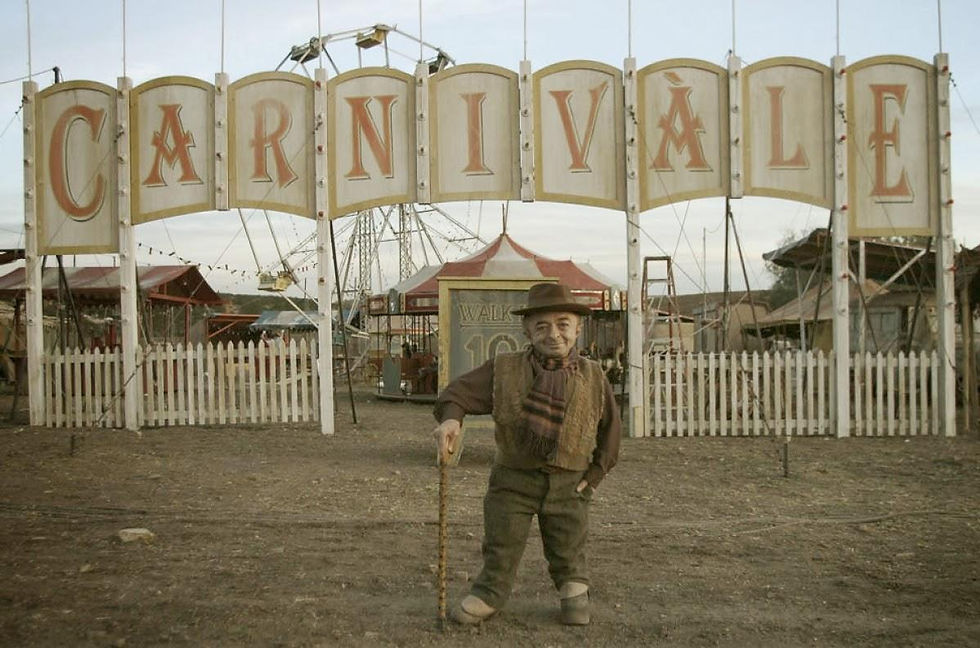
The Cooch Show and the Sermon
In Carnivàle, there’s a family that runs the cooch show—the burlesque performance that draws the paying customers into the tent. It is, by any respectable standard, tawdry. Exploitative. The kind of thing decent people complain about to the sheriff.
And in the other storyline, Brother Justin delivers sermons. Beautiful, moving, theologically sophisticated sermons. He builds a church. He feeds the poor. He goes on the radio and speaks to thousands about salvation and moral clarity.
The cooch show is honest. The people performing know what they’re doing, know what the audience has come for, make no pretense about the transaction. There is a strange dignity in this. The refusal to dress exploitation in the language of virtue.
The sermon is a lie. Not because Justin doesn’t believe it—he does, which makes it worse. He believes in his own goodness with the ferocity of a man who has never looked at what lives beneath it. His certainty is the most dangerous thing in the show. More dangerous than any sideshow, any freak, any body that refuses to conform. Because certainty, in Knauf’s cosmology, is what darkness looks like when it puts on a suit.
I think about this when I read the language of the bills. “Recognizing transgenderism as a mental disorder and affirming the biological reality of two genders.” The syntax of certainty. The sermon voice. The absolute confidence that the taxonomy is not a construction but a truth. Ordained, biological, biblical, inviolable. The people writing these bills believe in what they’re doing. That’s what breaks me. Not the cynics. The sincere.
I grew up around that sincerity. It mowed the lawns. It went to church. It smiled at the neighbors and said how are you without wanting an answer. And underneath the sincerity, like a basement nobody talked about, was a terror of anything that couldn’t be filed in the approved categories. The suburbs weren’t peaceful. They were suppressed. And the suppression required constant maintenance. Of borders, of definitions, of the line between us and them that made the whole arrangement feel like safety instead of what it was.
Brother Justin is always sincere. The carnival, with its fake freaks and real freaks and everything in between, never pretends to be anything other than what it is. The church—the legislature, the regulatory body, the institution that draws the line between normal and abnormal—wraps its violence in the language of protection. Of children. Of women. Of biological truth. Of God’s plan.
The cooch show never claimed to be saving anyone.
Sontag at the Bedside
I keep coming back to her. I can’t help it. She’s the ghost in this essay, the figure who embodied what she critiqued, who mapped the territory and then refused to admit she lived there.
In 1989, when she published AIDS and Its Metaphors, her community was dying. Not the community of public intellectuals. Though that too. The queer community she had moved through for decades, drawn from, been shaped by, never publicly claimed. The drag queens and the leather men and the artists and the dancers and the people who had built an entire culture of survival inside a society that wanted them gone. They were dying by the thousands, and the metaphors the culture used to describe their dying—plague, punishment, contamination, the wages of sin—were doing a secondary violence that Sontag was uniquely equipped to name.
And she named it. Brilliantly. From behind glass.
The essay on AIDS does what Sontag always did: it takes the thing that is breaking the world and subjects it to the discipline of her intelligence until the mechanisms are visible. She shows how the plague metaphor dehumanizes. How the military language of immune systems “fighting off invaders” turns illness into a war the patient is losing. How the association between AIDS and moral failure creates a taxonomy of deserving and undeserving sick.
But she does this without entering the room. Without sitting at the bedside. Without saying: these are my people, and they are dying, and I am one of them.
I was in the Castro when the rooms were full of dying. I wasn’t queer. I wasn’t sick. I was a kid with a camera who had stumbled into the middle of a catastrophe and couldn’t leave because the people inside it were more alive than anyone I’d met in the world I came from. And I learned something Sontag’s essays never taught me: you don’t have to understand a community to show up for it. You don’t have to belong to sit at the bedside. You just have to be willing to be there with your whole self, not your analytical self, not your professional self, not the self that writes the penetrating review. Your whole clumsy, inadequate, fully present self.
The lectern or the bedside. The analysis or the presence. Camp Sontag could map the aesthetic from the outside. AIDS Sontag could critique the metaphor from the outside. Arbus Sontag could judge the photographs from the outside. What she could not do—what the gaze, her gaze, the intellectualized gaze, could never do—was enter the carnival.
I don’t say this to diminish her. The tools she built—the way she taught us to see how language shapes what it describes—are indispensable. I’m using them right now. But indispensable tools are not the same as presence. And presence—being in the room, in the body, in the community of people the culture has decided are grotesque—is what the moment requires.
It is what the moment has always required.
The Inside of Everyone
A recent essay argued that we’ve had Arbus wrong all along. That her true subject was never deviance. It was dignity. Not the dignity that comes from performing normalcy, but the dignity that lives inside the experience of being observed. The extraordinary variety of ways that human beings meet the gaze of another.
Three photographs from the collection of Lily Tomlin and Jane Wagner—two women who had spent careers being looked at—make the case. A teenage couple on Hudson Street, locked in the tender awkwardness of young love. Two ladies at the Automat, sharing the quiet companionship of a weekday lunch. Four people at a gallery opening, establishment figures in evening dress, every one of them performing a slightly misaligned version of ease.
Seen together, the argument is clear. Arbus was not pointing at the strange. She was illuminating the strangeness that lives inside the ordinary. Every social occasion is a performance. Every portrait is a negotiation between the self you are and the self you present. The so-called freaks simply did this negotiation in public, with higher stakes, in bodies the culture had already decided were unacceptable.
This is what Sontag missed. She assumed the discomfort in the photographs belonged to the subjects. But the discomfort belonged to her. To anyone who looked and felt the categories start to slip. Arbus wasn’t interested in outsiders. She was interested in the inside of everyone. The gap between the role being played and the person playing it. The mask that every human wears, whether the culture has given them permission to call it a mask or not.
The suburban family on the lawn is performing family. The transvestite in the dressing room is performing gender. The nudists at the camp are performing the absence of shame. The kid from the suburbs with the SLR is performing belonging in a world she doesn’t yet understand. They are all doing the same thing. Arbus just made it visible.
A Carnival of the Willing
There’s a moment in Carnivàle that I’ve never been able to shake. A character named Dora Mae—one of the carnival’s performers—is found hanging from a tree outside a mining town. The image deliberately evokes the history of lynching in America, making visible the connection between freakdom and racial othering, between the body that doesn’t conform and the body that isn’t white, between the performance of difference and the punishment for it.
Knauf understood that “freak” is a class issue. A designation, not a description. A tool the majority uses to manage its own terror in the face of variation. The traveling carnival of the 1930s was not a zoo. It was a community of people who had nowhere else to go, who had been sorted out of acceptable society and built something provisional and real in the margins. They took their difference—whether it was physical, behavioral, or simply a refusal to conform—and made it a living. Not a good living. But a living.
The towns they passed through wanted two things from them: entertainment and departure. Come, display your strangeness so we can feel normal by comparison, and then leave before our children start asking questions.
This is still the deal. The culture will tolerate the carnival. Will watch the drag shows on television, will stream the documentaries about trans lives, will consume the aesthetic of queerness in fashion and music and design. As long as the performers know their place. As long as they stay in the tent. As long as they don’t try to use the bathroom at the county courthouse.
Seven hundred and thirty-eight bills. That’s the culture saying: the show is over. Get back in the truck. Move along.
In February, a woman in Kansas named Hazel Krebs woke up and learned her driver’s license had been invalidated overnight. No hearing. No warning. No grace period. A new law had taken effect while she slept, retroactively canceling the licenses of every transgender person in the state who had updated their gender marker. Krebs has pink hair. She wears makeup and dresses. The letter from the state told her she now has to carry an ID that says M. When she goes to pick up a prescription, when she applies for a job, when she gets pulled over on the way to the DMV to collect her corrected documents, the card in her wallet will tell whatever stranger is looking at it that the state has decided it knows who she is better than she does. This is what the taxonomy looks like when it arrives in your mailbox. This is the form. Check one.

The Machine Beneath
What is the gaze, finally? What is the thing I’m circling?
It is not seeing. Seeing is neutral. Light entering the eye, data reaching the brain. The gaze is what the mind does with the seeing. The instant categorization. The prapañca. The rush to sort the person in front of you into a taxonomy that makes the encounter manageable and the person smaller than they are.
Arbus spent her career trying to capture the moment before the gaze. Merchant sang about the moment of discovering the gaze. Knauf built a mythology around the community that formed on the other side of the gaze. And Sontag—Sontag analyzed the gaze while pretending she didn’t have one.
They are four points on the same compass. Four ways of reckoning with the fact that human beings cannot encounter difference without trying to contain it. That the mind, confronted with a person who doesn’t fit the available categories, will generate new categories before it will sit with the discomfort of not-knowing. That this reflex—this ancient, automatic, deeply human reflex—is the raw material of every taxonomy of exclusion ever devised.
The bills know this. The people who write them know this, even if they’d never use this language. They know that if you let the uncategorized person exist. If you let the body that doesn’t conform move through public space without being sorted, defined, regulated into a manageable shape. Then the categories themselves come into question. And once the categories come into question, the entire architecture of normal collapses.
But it goes deeper than that. The culture doesn’t just fear the uncategorized person. It fears the encounter with the uncategorized person. Because encounter is where categories dissolve. You can pass a thousand bills defining sex, but if two people stand face to face long enough—if one of them looks and the other looks back and neither of them flinches—the definitions start to feel like what they are: paper. Administrative paper. And the person is still there, still breathing, still more real than any form the state can print.
That’s what’s at stake. Not bathrooms. Not sports. Not the protection of children or the integrity of biological science or any of the language the sermons use. What’s at stake is the right to not-know. The right of the comfortable to remain comfortable. The right to look at a person and immediately, automatically, below the threshold of awareness, sort them into a category that keeps the world legible and the self intact.
The freak threatens this. The freak has always threatened this. Not by being different. Difference is everywhere, is the fundamental condition of existence, is what the Buddhists mean when they talk about dependent origination and what the physicists mean when they talk about entropy. The freak threatens the system by being different visibly. By refusing to hide the difference. By standing in front of the camera, in front of the microphone, in front of the congregation, in the public bathroom, at the driver’s license office, and saying: I am here. I am not your category. Look at me anyway.
What Remains
Arbus photographed a transvestite at her dressing table in 1966. The subject—a person whose name I don’t know and won’t presume to guess—is looking directly into the camera with an expression that I have spent years trying to describe and cannot. It is not defiance. It is not performance. It is not the vulnerability the viewer might project onto a person in a slip and a wig in a room that needs painting.
It is, I think, patience. The patience of someone who has been looked at so many times, in so many ways, by so many people who needed the looking to confirm something about themselves, that the act of being seen has become almost restful. The subject has metabolized the gaze. It no longer does anything to them. It passes through, like light through glass.
I have seen that patience. On Silom Road. In the Castro. In every face that has been stared at so long the staring becomes weather. Something you dress for, accommodate, no longer take personally. Call it something fiercer and quieter than resignation. It is the knowledge that the person staring needs the staring more than you do.
This is what the bills cannot reach. This is what the taxonomy cannot contain. You can redefine sex. You can invalidate licenses. You can strip markers and ban care and make the existence of a body a crime. But you cannot legislate away the person looking back at you from inside a life you will never fully understand. The person who has already passed the test. The person who has been looked at and looked at and looked at, and who is still there. Still looking back.
The 1972 Arbus retrospective at MoMA drew the highest attendance in the museum’s history. Millions of people came to see the photographs of freaks. And the photographs looked back. And something happened in the room that no amount of Sontag’s criticism could explain away. A transaction between the viewer and the viewed that dissolved, for just a moment, the line between them.
That moment is what the legislation fears.
That moment is what the carnival has always offered.
The Closing Gaze
It is 2026. Seven hundred and thirty-eight bills. Forty-two states. A coordinated effort, model legislation circulated with minimal changes, a machinery of classification designed to do what classification has always done: make the person disappear inside the category.
And somewhere, right now, a person who doesn’t fit the taxonomy is getting dressed. Doing their hair. Walking out the door into a world that has decided they are a legislative problem to be solved. They are not a problem. They are not a category. They are not a definition in a regulatory framework.
They are an aristocrat. They have already passed their test.
Arbus would have photographed them at eye level, same Rolleiflex, same square frame, and in the resulting image you would see not otherness but the universal human negotiation between the self you are and the self the world allows you to be. Merchant would have walked beside them on the street, Leica in hand, and later, alone, asked herself the question that matters more now than it did in 1995.
Knauf would have put them in the carnival. Among the other freaks, the other outcasts, the other people who built a family because no family would have them. And he would have made them the moral center. He would have given them the gift of being seen not as symbols but as people. Flawed, funny, exhausted, profane, compassionate, real.
And Sontag—Sontag would have written about it. Brilliantly. From behind glass.
The question is not what we see when we look at the people the culture calls freaks.
The question is what we see when they look back.
The question is what we do with the silence that follows. The half-second after the gaze meets the counter-gaze, when the categories have not yet formed, when the person in front of us is still a person and not a taxonomy, when the discomfort of not-knowing is all there is.
Merchant asked it thirty years ago. She walked the streets of New York with a Leica, photographing strangers in black and white, performing the Arbus gaze without naming it. And then she turned the camera around.
Have I been wrong? Have I been wise, to shut my eyes and play along?
Three years later, she answered. In the video for “Kind & Generous,” Merchant is no longer walking the streets with a camera. She is inside a traveling circus, performing alongside actual sideshow artists, wearing their costumes, taking on their guises. The woman who asked have I been blind answered with her body. She put down the Leica and joined the show. And the song she sang from inside the carnival was not a reckoning. It was gratitude.
That is the question this moment hands us. Not as theory. Not as metaphor. Not as a critical framework to be admired from behind a lectern. As a choice. The gaze or the encounter. The analysis or the presence. The glass or the room.
Arbus chose the room. She went to the birthday parties. She sat in the dressing rooms. She spent years earning the trust that made her photographs possible. She didn’t just look. She entered.
That’s the act the seven hundred and thirty-eight bills cannot legislate away. Not the seeing. Not even the being seen. But the moment after. The moment when seeing becomes meeting, when the gaze dissolves into contact, when two people stand on the same ground and one of them does the simplest, most radical thing a human being can do in the presence of someone the culture has told them to fear.
Open your eyes.
Don’t look away.
Say hello.
©2026 Gael MacLean


