
Why Am I Homesick for a Place I’ve Never Been

Notes on connection and the ground tone
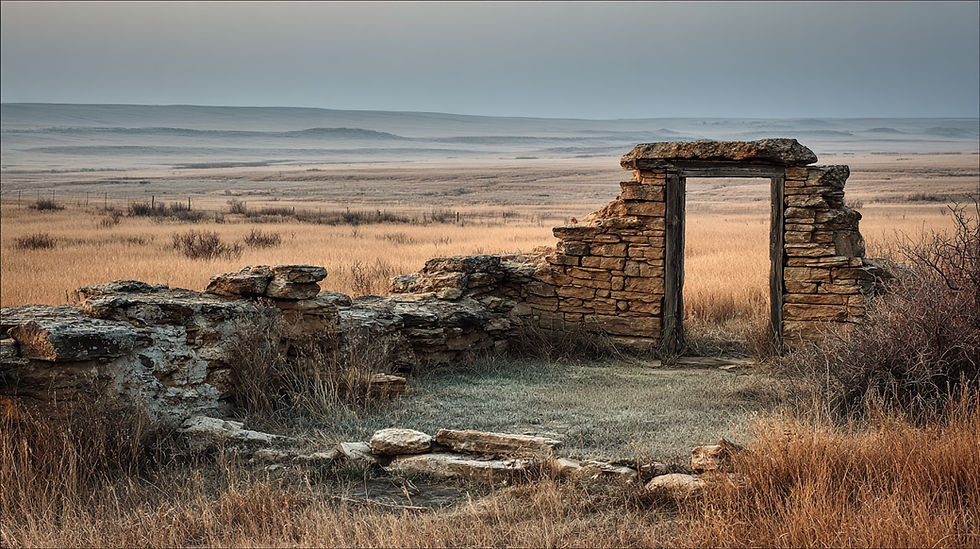
I found the line again the other day, in a notebook I have carried through forty-some years and four countries and more boxes than I can account for. The ink has gone the color of weak tea. The handwriting is a stranger’s — younger, faster, more certain of things. I was under twenty years, somewhere on the PCH (Pacific Coast Highway), thumb out, pack at my feet, waiting for a ride that may or may not have come. I don’t remember the weather. I don’t remember where I was going. What I wrote was this:
Why am I homesick for a place I’ve never been.
No question mark. I notice that now and I didn’t then. The girl who wrote it wasn’t asking. She was reporting a condition, the way you’d report a fever — not seeking a cure so much as naming a heat. I thought, in the way the young think, that the next ride would fix it. The next town. The next horizon, which is the only thing a person on the side of a road actually believes in. I was sure the missing place was geographical and that if I kept moving I would arrive.
I have spent the forty-some years since arriving at the understanding that I was looking in the wrong dimension.
* * *
The Germans, who have a word for most of the conditions the soul can fall into, have two for this. Heimweh is the ordinary one — home-pain, the ache to go back. And then there is Fernweh: far-pain, the ache for the distant, for the place over the next ridge you have never seen and cannot name. Most translators render it as wanderlust, which is a thin and cheerful word, a word for travel brochures. It is not what Fernweh means. Fernweh is wanderlust the way grief is a mood.
What I had written in that notebook was stranger than either, because it was both at once. Homesick — Heimweh — for a place I’d never been — a Ferne. The two words colliding inside a single sentence, canceling and intensifying each other. Homesickness aimed not backward at a remembered home but forward, or outward, or downward, at a home that had never been on any map I’d held.
The Welsh call something near it hiraeth — a longing for a home you cannot return to, or that perhaps never was. The Portuguese have saudade, the presence of an absence, the ache shaped exactly like the thing that is gone. The Romanians have dor. Notice that English, the most acquisitive language in human history, a language that has stolen words from everyone it ever met, has no single word for this. We say “homesick” and reach for the prefix of another tongue. I have come to think the gap is itself a piece of evidence. We lost the word around the same time we lost the thing.
It is, in any case, very old. Sixteen hundred years ago a North African bishop wrote a sentence that has outlived every empire standing at the time: You have made us for yourself, and our heart is restless until it rests in You. Augustine was not describing a phase, or a youth, or a road. He was describing a design specification. The restlessness is not a malfunction. It is the factory setting. We are built homesick.
* * *
I want to be careful here, because there is an easy version of this essay and it is one sentence away at every turn.
The easy version says: things were better once, and we have fallen from them. It locates the home in the past and grieves a vanished golden age, and it is wrong, and it is wrong in a way that matters, because golden-age grief is the exact emotional fuel that the worst movements in history have always run on. Make it like it was. I am not writing that essay. I would burn this notebook before I wrote that essay.
The home I am homesick for was never occupied. Not by me, not by my grandparents, not by anyone. It is not a lost past. Even the girl on the road understood this much without being able to say it: she was homesick for a place she had never been. The home is not behind us. It is not in any decade. It is more like a magnetic north that orients every compass and that no one has ever stood upon. You can be pointed toward it your whole life and never arrive, and the pointing is not failure. The pointing is the most human thing you will ever do.
It helps to think of the phantom limb. A person loses an arm and goes on feeling it for years — feels it ache, feels the weather in a hand that is no longer there. This happens because the map of the arm persists in the brain after the arm is gone. The body’s sense of itself outlives the body. And I have come to suspect we are all of us amputees of a commons we never had limbs in — that we carry, encoded somewhere ancestral and deep, the map of a way-of-being-together that the world has never quite delivered, and that we feel the weather in it constantly. The limb was never there. The map is real. The ache is the map, insisting.
* * *
Which brings me, by a road I did not expect to take when I started, to a German nun who has been dead for eight hundred and forty years.
I cannot tell you precisely when I fell into the music of Hildegard von Bingen. I can tell you what happens when I put it on now, alone, usually toward evening. The voices rise and do not resolve. They climb in long unhurried arcs and hang in the air like the smell of cold stone, and they refuse — this is the thing — they refuse to do what eight centuries of music since have trained my ear to expect. There is no chord that tightens and then releases. No cadence that says and now the feeling is over, you may relax. The melody simply opens a space and stands inside it.
Her music is modal, which means it predates the entire machinery of major and minor that we inherited later and now mistake for nature itself. It has not yet been sorted into happy and sad. It just is. And underneath it, in her world and in nearly every pre-modern music on earth — the bagpipe’s held note, the tanpura under a raga, the bourdon of the hurdy-gurdy, the drone beneath the chant — there is a single sustained tone that never changes. The melody wanders. The drone stays. And it is the drone, the unmoving ground note, that makes the wandering mean anything at all. Take it away and the melody is just a sequence of pitches. Lay it back down and every note becomes a relationship — a distance from home, measured against a home that is always sounding.
She had a word for the thing the music was tuned to. Viriditas. The greening. The moist force of life she believed moved through plant and stone and blood and word, the divine vitality that makes a thing more than its parts. She did not mean it as poetry. She meant it the way you mean the word gravity. And here is what undid me when I finally understood it: viriditas is itself a longing-word. Hildegard was not reporting from inside the home. Her music is not a postcard from the place I’m homesick for. It is a reaching toward it. She composed the way the wind moves. Not because she chose to, but because she had spent her life out of doors, listening to a world that does not resolve. The modal is what being-in-the-world sounds like before you have been taught to expect a cadence. She was homesick too. In the twelfth century, in a stone tower on the Rhine, with the whole cosmos still assumed to be ensouled and singing — she was still hitchhiking. The home was over the ridge for her as well.
So I will not tell you Hildegard’s century was the home. It wasn’t. But her century still knew how to build honestly around the absence. It had the drone. It had the pilgrimage, the prayer, the modal scale that hangs and does not resolve — whole architectures, sonic and civic and spiritual, erected around the permanent fact of the ache. The ache was understood to be structural, and so it was housed.
I should admit that I know this from the inside. I have spent years building drones — not borrowing them but making them, out of the world’s own materials. Whale song stretched until it stops being a whale. The calls of animals. Once, the voice of a man on a foreign broadcast haranguing a crowd in a language I do not speak, slowed and sustained until the meaning fell away and only the tone was left. And here is the thing I was not prepared for, the thing I have never quite recovered from: when you strip the resolution out of the propaganda, when you return the haranguer’s voice to its ground tone, what is left underneath is longing. He sounds homesick too. He is reaching for the home with everything in him. He has simply accepted the counterfeit — but you can hear, once you slow him down past the point where the threat lives, that the ache he is exploiting is the same ache it preys on. I have held that voice in my hands. The whale and the demagogue, the same tone humming under both.
Then, beginning around the year sixteen hundred, Western music did something extraordinary and, I have come to believe, revealing. It abolished the drone. In its place it built functional harmony — chords that move, that generate tension, that demand resolution. Music stopped being a thing you stood inside and became a thing that went somewhere. Every note now had to justify itself by motion, had to be leading to the next note, had to earn its keep by resolving. Nothing was permitted to simply be the ground. And we called this progress, and in a thousand ways it was, and I would not give up Bach to get the drone back.
But I notice the timing. The drone vanishes from our music at precisely the moment the modern self is being invented — the lonely sovereign individual, cut loose to generate its own meaning from scratch in a universe gone silent. The word Fernweh itself is not ancient. It surfaces in German in the nineteenth century, in the Romantic era, just as the factories start and the fields begin to be paved. The word for the ache is born at the very moment of the wound. We needed it suddenly because we’d just done something to ourselves we’d never done before. We’d composed out the ground tone and were standing, for the first time, with nothing sounding underneath.
* * *
I have been carrying, alongside the nun, a man who died in a hotel room in Oregon in the summer of 2002, four years after he and Tracy Grammer made the only record of theirs I cannot listen to without stopping whatever I’m doing.
Dave Carter wrote a song called “Grand Prairie, TX: Homesick Blues.” It is three chords. D, G, A. The plainest harmony in American music, the harmony of the Carter Family and Woody Guthrie and every front porch that ever held a guitar. Major key, wide open, almost cheerful. And over the top of this sunlit, square, untroubled harmony, Carter sings one of the most desolate lyrics I know — a man back in the town he came up in, finding it strip-malled and stranger-haunted, the one horse in forty miles penned in the Dallas zoo, working the graveyard shift at a Burger King that stands where his life used to be. He asks where his brothers have gone. He comes home to thank them for what they gave him.
And then he says: but the field is paved.
Four words. He does not say suburbanization. He does not say late capitalism or the developer-industrial complex or the severing of the American relationship to land. He says the field is paved, and you know exactly what he means and exactly what time it is and exactly what has been done, and he never had to name a single thing.
Notice what he refuses to do. He has every chord he needs to make this song sound as sad as it is. A turn to the relative minor. A borrowed chord, a shadow, the easy harmonic gesture that tells the listener now you may grieve. He declines all of it. He sings the homesickness in plain, unflinching major, and that refusal — that level voice over the open chords — is what makes it unbearable. He will not perform the grief. He lays it at your feet and trusts you to do it yourself.
It is, I realized with something close to vertigo, exactly what Hildegard does. Nine centuries apart, in a Latin chant and a country song, the same discipline: neither one performs the emotion. Neither resolves it for you. Both keep faith with the ground tone by refusing the cadence, by leaving the space open and trusting you to hear what is missing. They are doing the same thing. They are pointing at the same home.
And they reach the listener the same way, which is the thing I want to say carefully because I think it is the hinge. Hildegard’s listeners could not read. Most of them never would. They received the cosmos through the chant — modal scales widening into the vault of the cathedral like the inside of a great lung, the body filled before the mind had a chance to object. They did not understand the music. They were received by it. The expanses of the modal were a kind of architecture: a sonic cathedral the body could enter even when the mind could not read the inscription above the door. The music was the building. You walked in. You knew nothing. You felt everything.
Eight centuries later, the man in the pickup truck with Carter on the radio receives him the same way and for the same reason. The three chords are plain because plainness is the format the body trusts. Plainchant. Plain harmony. The word keeps surfacing because the work keeps doing the same thing — opening a room large enough to feel something in, and refusing to tell you what to feel once you are in there. Hildegard’s room is the cosmos. Carter’s room is the kitchen of childhood. Same architecture, opposite directions, same listener walking in carrying whatever she brought. The longing lives in the body, not in the argument. So the art that reaches it has to land in the body first. Which means it has to be plain. Which means it has to leave room.
* * *
So now I can say the part I have been circling, and I will say it once, and then I will leave it where it falls.
What we have lost is not connection. I want to be precise about this because it is where the easy version of the essay does its real damage. The people who commit the great crimes are almost never disconnected. They are, very often, ecstatically connected — to a tribe, a flag, a grievance, a leader, a vision of restored greatness sung very loudly in one room. They have a home. The home is just small, and walled, and built on the exclusion of everyone outside it.
What they have lost — what we are all at risk of losing — is connection to the ground tone. To viriditas. To the assumed kinship beneath difference, the thing that does not need to be argued for because it is simply sounding underneath. And here is the harmonic truth at the dark heart of the whole century: the counterfeit home is the anthem. It is functional harmony at its most coercive — it tells you precisely when to feel, it resolves on command, it admits no ambiguity and brooks no drone. Tyranny, it turns out, has a harmonic preference. It hates the modal. It cannot abide a note that simply hangs there, refusing to declare which side it is on. It needs every phrase to resolve, and to resolve to us against them.
The homesickness is not the danger. The homesickness is the most truthful thing in us. The danger is what gets sold to cure it. The ache is eternal — Augustine had it, Hildegard had it, the girl on the road had it. What has changed in our particular moment is not that the ache is new. It is that we have demolished the honest structures that once housed it — the drone, the pilgrimage, the commons, the modal scale that lets the longing simply be — and into that vacancy a market has rushed, selling counterfeits at scale. Loud ones. Simple ones. Anthems. And a vacancy will always be filled. That is the law I most wish were not true.
I have spent years returning again and again to a few words someone scratched into a cellar wall — no one knows who, so I will call her she — words written while the world she lived in was being retuned, by force, into the most coercive anthem in human history. She wrote that she still believed in the sun even when it wasn’t shining, in love even when she couldn’t feel it, in God even when He was silent. Under maximum pressure to accept the counterfeit — and there has never been a louder or more total counterfeit offered to human beings — she kept faith with the drone. She kept believing in the ground tone when every instrument around her had been forced into a single, deafening, resolving chord. Even when He is silent. That is a person refusing to mistake the loudness of belonging for the depth of it. Hildegard would have understood her in an instant. So would Carter. So, I think, would the girl on the road.
* * *
Here is why it matters, and I want to say it quietly, because the instant this essay raises its voice it has joined the thing it stands against.
Think about what I was actually doing on that highway. A girl, not yet twenty, alone, thumb out, waiting for a ride that may or may not have come. It came. Not always, and never on schedule, but it came, or I would not be here to write this. And every time, it came because a stranger slowed down — someone who had never seen me, would never see me again, who stood to gain nothing by it, and who pulled onto the shoulder and opened a door anyway. No accounting of self-interest explains it. They stopped because, underneath every difference between us, they could still feel that the girl on the roadside was kin. They could still hear the drone.
That is what the ground tone is for. It was never only an aesthetic, or a mood, or a private ache to be savored on the right kind of melancholy evening. It is the faculty that lets us care for what is not ourselves and not our tribe and not our use — the stranger on the road, the animal whose voice I would later stretch into song, the field before it was paved, the people not yet born who will inherit whatever we trouble ourselves to keep intact. Care does not come from argument. No one in the history of the world was ever reasoned into loving a stranger. It comes from felt kinship — the recognition that the other is one more instance of the same thing sounding. When you can hear the drone, the stranger is not a stranger. When it goes quiet, the stranger is only an obstacle, a competitor, a member of the group that is not yours.
And a civilization — this is the part we have somehow contrived to forget — is nothing but a vast and improbable act of caring for what you will never collect on. It is old people planting trees in whose shade they will never sit. It is keeping a road open for travelers you will never meet, a law for strangers not yet conceived, a coastline and a climate for descendants whose faces you will not live to see. Every durable thing our species has made rests on the willingness to spend ourselves on what lies outside the self, outside the tribe, outside the lit window of the now. And that willingness rests, all the way at the bottom, on the drone. Sever it, and the lonely sovereign self generating its own meaning in a silent universe is left with no reason on earth to preserve anything beyond its own walls. It will still feel connection. It will feel it ferociously. But only the walled kind, only the anthem — and the anthem has never once, in all of history, preserved a forest, or a stranger, or a child on the wrong side of a border. It does not preserve. It consumes. It was built to.
No one picks up hitchhikers anymore. We tell ourselves the road got more dangerous, and perhaps it did. But I have come to believe the truer thing is quieter and worse: the drone went out, and the girl on the shoulder stopped sounding like kin. She became a risk to be calculated, a stranger in the new and total sense of the word. Somewhere in the forty-some years between that ride and this sentence, we lost the ability to hear, in a raised thumb at the edge of a road, the thing that would once have made us slow the car. The field is paved. So is the shoulder of the road.
She is still on the road, that girl, in the only sense that matters. The thumb is down now and there are dogs in the truck and the highway is quieter and lined, for two thousand miles, with the same six logos. But she is still going, and she is still homesick, and after forty-some years I have finally stopped mistaking that for a problem to be solved.
I think I understand now why I left no question mark.
A question mark wants an answer, and an answer is a cadence — it resolves the phrase, it tells you the feeling is over, you may relax. To answer the question would be to pave it. The girl, who knew nothing, knew the most important thing: she let the sentence hang. She wrote a modal line. A note with no resolution, sounding under everything she has done since, the drone beneath forty-some years of melody, the thing that gave all the wandering its meaning.
I am not going to define the home for you. I don’t believe it can be defined, and I think the attempt is itself a small act of paving. I have only played a few notes — a nun, a dead songwriter, four words about a field — and asked whether you hear them. If you do, you already knew. You have been carrying this as long as I have, and the whole purpose of these pages is for the two of us to find each other across the noise.
If you don’t, I am not going to convince you with argument, and I am not going to try. The longing cannot be argued into anyone. It can only be recognized. It is the oldest thing in us and it has no question mark and it does not resolve.
It just sounds, underneath. Always has.
Go outside. See if you can hear it.
©2026 Gael MacLean


